- Welcomed over 161,000 onsite visits, 30 percent free of charge.

- Brought engaging hands-on activities to 1,000 Head Start preschoolers and over 250 school-age kids through after-school and summer programs at inner-city community centers.
- Hosted nearly 1,200 low-income children and their family members at free Museum family nights.
- Conducted therapeutic visits for over 500 children and parents in 182 court-separated families.
- Took open-ended, creative play experiences to over 1,600 kids and family members at neighborhood parks and community events across Providence.
- Provided over 350 charitable memberships to children and families in need.

Thursday, March 31, 2016
2015 Year in Review
Did you know that in 2015, Providence Children’s Museum:


Friday, March 11, 2016
Art Around the Museum
One of the Museum's core values and defining features is the quality and beauty of its learning environment. With a commitment to art since opening in 1977, the Museum has commissioned or
accepted donations of work by artists – many of them local – for our
exhibits and public spaces. These vibrant murals and paintings,
intricate sculptures and carvings, and more introduce rich color and texture to every corner of the Museum, inspire creative exploration, and introduce children to art and artists.
Discover these Museum artworks – click below each image to learn more:
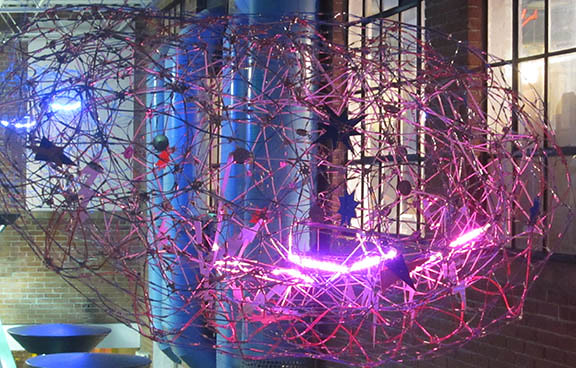
Discover these Museum artworks – click below each image to learn more:
Sunday, February 28, 2016
Research News

A chapter written by Dr. Sobel and the Museum highlights our National Science Foundation-funded project (award #1223777) to study how children understand their own learning processes and make their thinking visible to others through play at the Museum.
Learn more about the Museum’s research: www.ChildrenMuseum.org/Research.asp
Friday, February 19, 2016
AmeriCorps Alums on Staff
In addition to having a very well-established AmeriCorps program – which
just welcomed its 20th team this fall! – Providence Children’s Museum
also has an impressive number of AmeriCorps alums on its staff, who
shared these stories of their service:
Turenne Bedell, Volunteer & AmeriCorps Coordinator
AmeriCorps Service: 2005-06 Jumpstart; 2009-10 MuseumCorps
“After a successful term of service with Jumpstart while attending the University of Rhode Island, I looked into joining the PeaceCorps. Then I realized that there was a great need for service right here and so sought out a second AmeriCorps term in Rhode Island, where I've lived my whole life. When I was accepted to the Museum’s program, I knew I had an opportunity to dig deeper into service and so served my term as the Volunteer Assistant. Now, five years later, I'm back home at the Museum, as the Volunteer & AmeriCorps Coordinator – mentoring and supporting the AmeriCorps members whose seats I sat in just years prior!”
Megan Beauregard, Experience Coordinator
AmeriCorps Service: 2011-12 and 2012-13 MuseumCorps
“I started my work at the Museum as a Johnson & Wales work-study student. After nine months of playing in the Museum's exhibits, I was approached about joining the part-time AmeriCorps team and working with the full-time members at learning centers throughout Providence. As the summer progressed, I learned how much I loved providing a much-needed service to children and families in need, and my love for the Museum only grew. That's what inspired me to apply for the full-time team for 2012-13. As that year was coming to a close, a position for an Experience Coordinator opened up. I saw this as a sign that my time at the Museum wasn't finished yet, and two years later, I'm still here.”
Megan Fischer, Interim Executive Director/Director of Communications
AmeriCorps Service: 2002-03 City Year
“I moved to Rhode Island from Georgia after college to complete a year of AmeriCorps service. I ran an after-school program for grades 3 to 5 in Woonsocket, RI, discovered a passion for working with and mentoring kids in need, and was fortunate to have many opportunities to step into a leadership role. I also discovered the Children's Museum when I organized a special end-of-year field trip and saw how transformative it was for our students – who had many challenges in their lives – to have a chance to play freely and just be kids. I had an epiphany: I loved museums AND working with children, so why not work at a children's museum? After finishing AmeriCorps, I got an MA in Museum Studies at Brown University and came to the Children's Museum as an education intern with an interest in museum leadership. I'm still here nearly 12 years later, have held several different positions in that time, and often reflect on the foundation my AmeriCorps service gave me.”
Amanda Howard, Experience Coordinator
AmeriCorps Service: 2009-10 Scholarships for Service; 2013-14 MuseumCorps
“Service has always been a major part of my life. In college, I had the opportunity to do a part-time year of service with different organizations in and around Providence. When I was finishing graduate school, I was looking for a job and I saw the posting for Providence Children Museum’s MuseumCorps program. I really wanted to come back to Providence and I thought that this would be a great opportunity. For my year of service at the Museum, I got to work with the Head Start centers in Providence, Central Falls, and Pawtucket. After my year of service ended, I knew that I wanted to stay at the Museum and took a position as an Experience Coordinator. In my current role, I get to work closely with our AmeriCorps team and mentor them in our exhibits.”
Mandy Roach, Experience Coordinator
AmeriCorps Service: 2012-13 MuseumCorps, 2013-14 OSEEC
“Throughout grade school, nines times out of ten, the teacher standing in front of the classroom determined not only how well I would perform in that class but if I would enjoy the subject at all. Those teachers who listened, cared and seamlessly found a way to keep things interesting are the reason I decided to become an educator myself. Besides a life-long love for doodling, I received my degree in Art Education to pursue the idea of incorporating the creative arts into all fields and allowing students to become interactively engaged. That's when I discovered Providence Children's Museum’s AmeriCorps program and, after two years of service, my suspicions were confirmed: the traditional classroom was never the place for me!”
Robin Meisner, Director of Exhibits
AmeriCorps Service: 1998-99 MuseumCorps
“I joined the Museum’s AmeriCorps program after graduating from Brown University with a degree in chemistry and a love of working with young children... and what I thought was going to be a singular year of service turned into a career in museum education. Following my experience on the Museum’s Head Start team, I joined the staff for four years as the Museum’s science educator and developed exhibits and programs and led one of our AmeriCorps teams. After attending graduate school in London to focus on informal science education, I returned to the museum world and eventually made my way back to Providence. Having served on the Museum’s second AmeriCorps team and now seeing the 20th, I am truly impressed by how the program has both shaped our community and the Museum itself.”
Turenne Bedell, Volunteer & AmeriCorps Coordinator
AmeriCorps Service: 2005-06 Jumpstart; 2009-10 MuseumCorps
“After a successful term of service with Jumpstart while attending the University of Rhode Island, I looked into joining the PeaceCorps. Then I realized that there was a great need for service right here and so sought out a second AmeriCorps term in Rhode Island, where I've lived my whole life. When I was accepted to the Museum’s program, I knew I had an opportunity to dig deeper into service and so served my term as the Volunteer Assistant. Now, five years later, I'm back home at the Museum, as the Volunteer & AmeriCorps Coordinator – mentoring and supporting the AmeriCorps members whose seats I sat in just years prior!”
Megan Beauregard, Experience Coordinator
AmeriCorps Service: 2011-12 and 2012-13 MuseumCorps
“I started my work at the Museum as a Johnson & Wales work-study student. After nine months of playing in the Museum's exhibits, I was approached about joining the part-time AmeriCorps team and working with the full-time members at learning centers throughout Providence. As the summer progressed, I learned how much I loved providing a much-needed service to children and families in need, and my love for the Museum only grew. That's what inspired me to apply for the full-time team for 2012-13. As that year was coming to a close, a position for an Experience Coordinator opened up. I saw this as a sign that my time at the Museum wasn't finished yet, and two years later, I'm still here.”
Megan Fischer, Interim Executive Director/Director of Communications
AmeriCorps Service: 2002-03 City Year
“I moved to Rhode Island from Georgia after college to complete a year of AmeriCorps service. I ran an after-school program for grades 3 to 5 in Woonsocket, RI, discovered a passion for working with and mentoring kids in need, and was fortunate to have many opportunities to step into a leadership role. I also discovered the Children's Museum when I organized a special end-of-year field trip and saw how transformative it was for our students – who had many challenges in their lives – to have a chance to play freely and just be kids. I had an epiphany: I loved museums AND working with children, so why not work at a children's museum? After finishing AmeriCorps, I got an MA in Museum Studies at Brown University and came to the Children's Museum as an education intern with an interest in museum leadership. I'm still here nearly 12 years later, have held several different positions in that time, and often reflect on the foundation my AmeriCorps service gave me.”
 |
| Front – Mandy Roach, Amanda Howard, Megan Beauregard Back – Megan Fischer, Turenne Bedell, Robin Meisner |
AmeriCorps Service: 2009-10 Scholarships for Service; 2013-14 MuseumCorps
“Service has always been a major part of my life. In college, I had the opportunity to do a part-time year of service with different organizations in and around Providence. When I was finishing graduate school, I was looking for a job and I saw the posting for Providence Children Museum’s MuseumCorps program. I really wanted to come back to Providence and I thought that this would be a great opportunity. For my year of service at the Museum, I got to work with the Head Start centers in Providence, Central Falls, and Pawtucket. After my year of service ended, I knew that I wanted to stay at the Museum and took a position as an Experience Coordinator. In my current role, I get to work closely with our AmeriCorps team and mentor them in our exhibits.”
Mandy Roach, Experience Coordinator
AmeriCorps Service: 2012-13 MuseumCorps, 2013-14 OSEEC
“Throughout grade school, nines times out of ten, the teacher standing in front of the classroom determined not only how well I would perform in that class but if I would enjoy the subject at all. Those teachers who listened, cared and seamlessly found a way to keep things interesting are the reason I decided to become an educator myself. Besides a life-long love for doodling, I received my degree in Art Education to pursue the idea of incorporating the creative arts into all fields and allowing students to become interactively engaged. That's when I discovered Providence Children's Museum’s AmeriCorps program and, after two years of service, my suspicions were confirmed: the traditional classroom was never the place for me!”
Robin Meisner, Director of Exhibits
AmeriCorps Service: 1998-99 MuseumCorps
“I joined the Museum’s AmeriCorps program after graduating from Brown University with a degree in chemistry and a love of working with young children... and what I thought was going to be a singular year of service turned into a career in museum education. Following my experience on the Museum’s Head Start team, I joined the staff for four years as the Museum’s science educator and developed exhibits and programs and led one of our AmeriCorps teams. After attending graduate school in London to focus on informal science education, I returned to the museum world and eventually made my way back to Providence. Having served on the Museum’s second AmeriCorps team and now seeing the 20th, I am truly impressed by how the program has both shaped our community and the Museum itself.”
Sunday, January 31, 2016
New in ThinkSpace!
The Museum is committed to providing experiences that promote different types of play and to keeping fresh by frequently changing elements of our exhibits. Investigate two intriguing new drawing stations in ThinkSpace that challenge visitors’ spatial thinking:
The activities target older children and multiple kid testers talked about how they liked that it was tricky – that they couldn’t do it right away and had to keep trying. And adults were just as engaged as they tried to figure it out for themselves. The exhibits team enjoyed observing how kids naturally helped one another understand how to use each activity.

The team ultimately decided on two versions of the mirrored image activity to give different levels of challenge. They also opted to try out LCD writing tablets instead of using and wasting a lot of paper and are interested to see how visitors respond.
Research shows that spatial thinking is a skill you can improve with practice and the more visitors of all ages try these activities, the better they’ll get!
- Mystery Box Reach inside, feel a hidden object, and draw what it might be. This activity asks visitors to make careful observations using their sense of touch to identify the parts of an object and construct an image of the whole, then to create a drawing – a spatial representation – of what they think is inside the box.
- Mirrored Image Draw a picture or write a word so that it looks right-side up in a mirror. This activity encourages visitors to practice their spatial sense through an exploration of symmetry and mirroring.
 |
| Exhibits Director Robin observes kids trying out the mystery box prototype. |
The activities target older children and multiple kid testers talked about how they liked that it was tricky – that they couldn’t do it right away and had to keep trying. And adults were just as engaged as they tried to figure it out for themselves. The exhibits team enjoyed observing how kids naturally helped one another understand how to use each activity.

The team ultimately decided on two versions of the mirrored image activity to give different levels of challenge. They also opted to try out LCD writing tablets instead of using and wasting a lot of paper and are interested to see how visitors respond.
Research shows that spatial thinking is a skill you can improve with practice and the more visitors of all ages try these activities, the better they’ll get!
 |
| Exhibit Designer Chris practices his spatial thinking. |
Thursday, January 28, 2016
Snowflakes On Display
New in ThinkSpace, see close-up photographs of the intricate structures of snowflakes by Dr. Kenneth Libbrecht, a professor of physics at California Institute of Technology. Dr. Libbrecht studies the molecular dynamics of crystal growth, particularly how ice crystals grow from water vapor – or the physics of snowflakes. He has experimented with and perfected techniques for catching and photographing snowflakes, and he regularly grows his own designer snowflakes!
The ThinkSpace “geometry gallery” features changing displays of objects that provide strong visual representations of spatial thinking, highlighting shapes in everyday life and the designed environment. Studying snowflakes is a great way to explore their geometric properties and to practice recognizing patterns within shapes, then to classify snowflakes into types. Dr. Libbrecht has identified about 35 types of snowflakes and his photographs allow for the close study of the structure of snowflakes and their geometry.

Click here to see more of Dr. Libbrecht’s snowflake photographs, as well as other resources and activities exploring snowflakes, snow crystals and other ice phenomena.
 |
| Graphic designer Valerie Haggerty-Silva installing the display. |
The ThinkSpace “geometry gallery” features changing displays of objects that provide strong visual representations of spatial thinking, highlighting shapes in everyday life and the designed environment. Studying snowflakes is a great way to explore their geometric properties and to practice recognizing patterns within shapes, then to classify snowflakes into types. Dr. Libbrecht has identified about 35 types of snowflakes and his photographs allow for the close study of the structure of snowflakes and their geometry.

Click here to see more of Dr. Libbrecht’s snowflake photographs, as well as other resources and activities exploring snowflakes, snow crystals and other ice phenomena.
Friday, January 1, 2016
Happy...

Wishing you an abundantly joyful and PLAY-filled new year!
Can you identify where in the Museum you can find each of these images?
Also see Museum visitors ring in 2016 at our annual New Year's Eve ball drop:
Also see Museum visitors ring in 2016 at our annual New Year's Eve ball drop:
Subscribe to:
Posts (Atom)