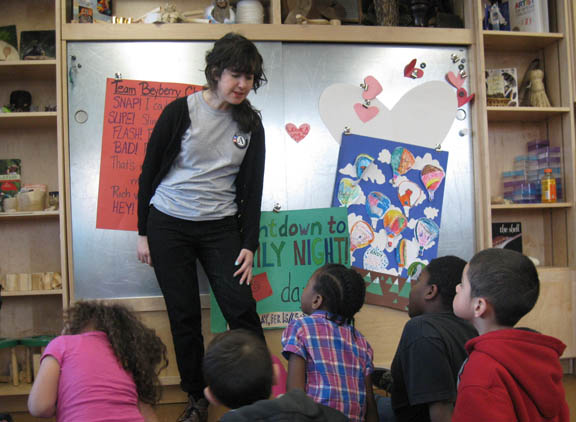
We’re reflecting on the incredible contributions of our AmeriCorps Museum Educators over the 2013-2014 service year. These stories were shared by members of the team that facilitated a Museum Learning Club at the Boys & Girls Club on the Southside of Providence and provided engaging STEM enrichment activities to 190 2nd to 4th graders.
One of our 2nd graders has trouble acclimating to lessons and is often reprimanded and scolded throughout the school day because of such issues. This day, he was acting out by knocking down the cup towers other children had made. I told him that I know how much fun it is to knock things down and we could do so together if he built his own tower first. When he responded that he didn't know how, I realized what the problem was and jumped on the learning opportunity. I tried several different methods until he finally grasped the concept of building cup towers, smiled and became completely engaged in the activity. A couple minutes in, one of his so-called rivals came over and he started to shoo him away. I suggested we could all build together and my heart melted as he handed his maybe-no-longer nemesis a cup and began teaching him how to build a tower the same way I taught him.
– Meg Conery
We were facilitating Imagination Playground and our kids were a little restless. There was a lot of pretend play happening, some of it becoming chaotic and all of it becoming loud. Right as the activity was reaching the point where we were going to have to reel everybody back in, I heard a shout. "THE QUEEN IS HERE! ATTENTION! EVERYONE LOOK UP!"
It was like magic. I had tried to get everyone's attention to lower the volume or remind them to be safe without success, but a small girl with a big voice froze the room in an instant. She announced the queen's arrival and made all of the subjects sit on the floor. She hired the other kids one at a time to work on constructing the castle, channeling what was loud, undirected play into thoughtful, purposeful pretend play. Every time the castle subjects were off task, the girl would redirect her peers. It was incredible to watch their ability to self-regulate and establish peace in their blue foam kingdom.
– Sarah Schnurr
Showing posts with label after-school. Show all posts
Thursday, August 28, 2014
Engagement: A Learning Club Story
We’re reflecting on the incredible contributions of our AmeriCorps Museum Educators over the 2013-2014 service year. This story was shared by Alison Rutsch, a member of the team that conducted after-school Learning Clubs exploring fun hands-on STEM (Science Technology Engineering and Math) activities for low-income elementary school-age kids in Providence, Pawtucket and Central Falls.
Throughout our spring Learning Clubs we ran a lesson called “Meet a Worm,” in which kids learn all about worms and then observe real live night crawlers. “Meet a Worm” is the lesson I’m most proud of creating. It included time for in-depth exploration using drawing as an observation tool, a dialogue with students about worms, and a crazy worm race on the carpet. We also created a worm true or false game and had a great time making up untruths about worms. I think the beauty of lesson is that it shines a new light on something that is part of our everyday environment, showing that the world is a really exciting place if you're just willing to look closely. A testament to this fact: one of our Learning Club kids went home and collected his own pet worms!
Friday, August 15, 2014
Saluting a Year of Service to Kids in Need
The Museum has been an AmeriCorps site since 1997 and has hired and
trained AmeriCorps members to bring play-based literacy, science and
math activities to more than 20,000 children in under-resourced
neighborhoods.
This week, we’re celebrating the graduation of the Museum’s 18th remarkable AmeriCorps team and their 22,000 hours of dedicated service over the past year. This group of 12 full-time members and four additional summer members extended the Museum’s reach to children and families in underserved communities in Providence, Pawtucket and Central Falls and had a tremendous impact. There’s so much the Museum simply could not do without the dedication and passion of these committed and talented individuals.
The Museum’s 2012-13 AmeriCorps team:
“One-thousand Head Start children experienced your creativity, your passion and your enthusiasm – please know you have made a difference in the life of a child.”
Our heartfelt thanks and congratulations to Ali, Alison, Amanda, Ashley, David, Faina, Hannah, Jack, Joey, Meg, Samantha, Sarah L., Sarah S., Tracey, Vanessa and Zoe!

The Museum’s AmeriCorps program is made possible by a grant from the Corporation for National and Community Service and Serve Rhode Island, with support from additional sponsors for the Head Start and Learning Club programs.
This week, we’re celebrating the graduation of the Museum’s 18th remarkable AmeriCorps team and their 22,000 hours of dedicated service over the past year. This group of 12 full-time members and four additional summer members extended the Museum’s reach to children and families in underserved communities in Providence, Pawtucket and Central Falls and had a tremendous impact. There’s so much the Museum simply could not do without the dedication and passion of these committed and talented individuals.
The Museum’s 2012-13 AmeriCorps team:
- Facilitated imaginative activities that celebrate diversity to help improve school readiness for 1,000 Head Start preschoolers in 58 classrooms
- Engaged over 500 elementary school-aged children with inspiring play-based math and science activities during after-school and summer Learning Clubs at Boys & Girls Club of Providence, Highlander Charter School and other community-based programs
- Welcomed 1,600 low-income children and family members to free Museum family nights, where they received complimentary year-long admission passes
- Recruited and trained dozens of Museum volunteers
- Engaged Museum visitors in hands-on exhibits and developed interactive public programs
- And much more!
“One-thousand Head Start children experienced your creativity, your passion and your enthusiasm – please know you have made a difference in the life of a child.”
– Ellen Morey, Children’s Friend“Thank you to this wonderful group of talented individuals. You each brought your passions, talents and skills to this incredible institution.”
– Marisa Petreccia, Serve RI“When the Museum first moved from Pawtucket to Providence, my dream was that our audience would be as diverse and varied as our community. You are the hands and voices and hearts and minds that bring our message to the community, and we do attract a richly diverse audience because of you. I’m very grateful for that.”
– Janice O’Donnell, Museum director“Thank you for keeping the Museum’s mission at heart all the time and for putting children first.”
– Olga Lerner, Museum Early Childhood Learning Programs Developer
Our heartfelt thanks and congratulations to Ali, Alison, Amanda, Ashley, David, Faina, Hannah, Jack, Joey, Meg, Samantha, Sarah L., Sarah S., Tracey, Vanessa and Zoe!

The Museum’s AmeriCorps program is made possible by a grant from the Corporation for National and Community Service and Serve Rhode Island, with support from additional sponsors for the Head Start and Learning Club programs.
Monday, August 19, 2013
Making Connections: Boys & Girls Club Stories
We’re reflecting on the incredible contributions of our 2012-13
AmeriCorps Museum Educators as their service year comes to a close.
These stories were shared by Dylan Maeby, a member of the team that
facilitated a Museum Learning Club at the Boys & Girls Club on the
Southside of Providence and provided engaging STEM enrichment activities
to 130 2nd to 4th graders.
Science Inspiration
“Potions” was the last in a series of lessons we developed about the science behind magic. We’d used static electricity to move objects without touching them, made flip books to show that pictures can come to life, and now we were using ingredients like “unicorn horn” (Alka-Seltzer) mixed with “dragon blood” (food coloring and water) to illustrate the power of chemical reactions. Throughout the lesson the kids were delighted as their mixtures bubbled and fizzed. Through careful observation, they determined which ingredients were responsible for the reactions they observed and which ones were not. A successful lesson for sure, we ended by combining all of the potions in one container for a final show.
When we arrived the next day, I was met at the door by a group of children. “Jaden has something to show you!” they told me. “I made this for you,” said Jaden, an often-rambunctious child, as he handed me a bottle filled with a combination of what looked like water, oil and food coloring. “When I went home yesterday I told my parents what we did and then I asked if I could make my own potions. This was the best one. It was hard to find the right balance of water and oil, but I did!”
He turned to walk away with a proud look on his face. A moment later he shouted, “Oh, I figured out that it wasn’t unicorn horn we were using, it was Alka-Seltzer!”
Building Bridges
Two sisters, ages 9 and 7, had been hard at work for well over an hour to create a suspension bridge from newspaper and string. They had unsuccessfully tried numerous times, yet they remained undeterred. Carefully adjusting the strings, taping then re-taping, the girls moved closer to accomplishing their goal. As the younger girl tested the bridge once again, her sister had a revelation. “We can do this at home!” she exclaimed. “We have all of the things we need.” They momentarily forgot about testing their bridge as they excitedly discussed all of the different materials they could use. Eventually they perfected their design but I couldn’t help but feel that the real success lay in the many hours of play yet to come.
Friday, August 16, 2013
Persistence: A Learning Club Story
We’re reflecting on the incredible contributions of our 2012-13
AmeriCorps Museum Educators as their service year comes to a close this
week. This story was shared by Alexandra Fleagle, a member of the team
that conducted after-school Learning Clubs for 12 community
organizations in Providence, Pawtucket and Central Falls and engaged
kids ages 6-12 in fun hands-on STEM (Science Technology Engineering and
Math) activities.
At Fox Point Boys & Girls Club, our Learning Club kids had challenging attitudes towards school, science, each other, and their own potential to learn. Over the first few weeks, we learned what they needed and slowly earned their trust. However, I wondered how they would respond to my lesson on acids, bases and the pH scale. It was content-heavy and involved “painting” with a solution of turmeric and alcohol. These kids made a mess with wet glue; what was I thinking giving them something that permanently stains?
It turns out I had nothing to worry about – the kids were engaged from the moment I began. I mixed vinegar and baking soda to demonstrate a neutralization reaction and talked about how chemical reactions create completely different substances. It was going so well that I took a risk and started talking about chemical formulae and ions. “Acids have high concentrations of H+ ions, while bases have OH- ions. When they come together, you have two ‘H’s and ‘O.’ Does anyone know what those atoms make?” Their eyes widened with excitement and recognition, followed by shouts of “H2O!” “Water!” “We just talked about this in school today!”
During the main activity, they experimented and discovered the pH of 10 substances. Juliette, who was often vocal about her dislike of school and science, was the most eager to get started. After a while I saw her sit down and asked if she had finished. “Let me tell you what I found!” she said, and proceeded to explain her results as well as her reasoning and hypotheses. During the post-experiment discussion, kids who usually didn’t talk were eager to share their discoveries, and we began to explore why they were important and how we use this science in everyday life.
Next, I introduced the art activity, explaining that we were trusting them to act responsibly with the turmeric. They rose to the occasion. Jayhoni had been one of the most cynical members of the group. It had been very difficult to engage, let alone impress, her with any of the activities. But as she was painting, I heard her exclaim, “This is awesome!” The rest of the Club agreed. It had been a very good day.
Thursday, August 16, 2012
Understanding: Boys & Girls Club Stories
This week we’re reflecting on the incredible contributions of our
2011-12 AmeriCorps Museum Educators as their service year comes to a
close. These stories were shared by Leah Paladino and John Rossi,
members of the team that served 133 kids in a Museum Learning Club at
the Boys & Girls Club in the South Side of Providence, where they
explored math concepts through engaging hands-on activities.
Hungry for Math
In an after-school setting, it is rare to hear a child profess his or her love for mathematics. Math is often a subject that students feel overwhelmed by and afraid of. Leading activities that mix in math at the South Side Boys & Girls Club is thus not an easy task. Hearing children recall that there are three feet in a yard or say that a hundreds chart is a useful counting tool feels great, but seeing them really understand math concept and use it without prompting is the best.
One Friday, several girls were playing with pattern blocks together, making designs and stacking them, when one girl made a “hamburger” out of her blocks. After pretending to gobble it down and claiming it to be delicious, a make-believe restaurant was founded. The adults in the room acted as customers while the kids created menus, the food, a waitressing and dishwashing system, and money, all from materials found in the room.
Without any adult aid, math was incorporated into a child-created activity – adding, subtracting, monetary values and estimation. Children enthusiastically worked at the “cash register,” adding up the prices from the menu and giving back the correct amount of change. Of course the prices were outrageous for the amount of food we received, but isn’t that how fine dining works?
A True Scientist
At the South Side Boys & Girls Club, it can, at times, be a struggle with our kids; so eager to learn but stumbling over obstacles in their lives. Some of our kids become disheartened, frustrated and may break down. At these points, we as educators also become frustrated. We have lessons set out for them and we want them to reach goals. But as role models and friends, we also know the importance of calling a time out. Letting kids vent, be silly, or even take a day off from Museum Club are important parts of the learning process. We need to be aware of the ever-changing dynamics for each child, and to acknowledge the difficulties that come with being a kid before they come to a head.
One of our “all-stars,” a fifth grader named D’Zire, had “one of those weeks.” Nothing seemed to be going right; homework and school, interactions with friends, not even our activities. D’Zire was working on string telephones, and we just couldn’t get her voice through the cup and across the string to my ears. Seeing her frustration building, I called a time out. “D’Zire, let’s take a walk and think about this.”
Surprised, she looked up and was at first hesitant. I nodded toward the door, and she calmly got up and headed out. We talked about how she was disappointed with a test score that day, and how she didn’t get to dinner in time at the Club. She just wanted the cups to go right, and not even our designed activity would work for her! I just listened, and when we had done a lap of the club we headed back in. Suddenly, she said, “What if we made the string longer?” “How much longer?,” I asked. “I think three or four inches will do it. Right now, it’s only about five inches long. I think all we’re hearing is each others' real voices, not the vibrations of the string.”
I was blown away. She had been solving this problem in her head the whole time. She is a true scientist, always thinking. She was able to connect the math involved with increasing the length of the string with the phenomenon of the sound’s vibration across it. It was able to travel the greater distance, as long as the string was taut. When she cleared her mind to me on our little walk, it became clear as day to her. She knew how to tackle the problem.
That is our job, rolled into one 10-minute block. These kids are brilliant, sometimes we just need to be there to flick the switch.
Hungry for Math
In an after-school setting, it is rare to hear a child profess his or her love for mathematics. Math is often a subject that students feel overwhelmed by and afraid of. Leading activities that mix in math at the South Side Boys & Girls Club is thus not an easy task. Hearing children recall that there are three feet in a yard or say that a hundreds chart is a useful counting tool feels great, but seeing them really understand math concept and use it without prompting is the best.
One Friday, several girls were playing with pattern blocks together, making designs and stacking them, when one girl made a “hamburger” out of her blocks. After pretending to gobble it down and claiming it to be delicious, a make-believe restaurant was founded. The adults in the room acted as customers while the kids created menus, the food, a waitressing and dishwashing system, and money, all from materials found in the room.
Without any adult aid, math was incorporated into a child-created activity – adding, subtracting, monetary values and estimation. Children enthusiastically worked at the “cash register,” adding up the prices from the menu and giving back the correct amount of change. Of course the prices were outrageous for the amount of food we received, but isn’t that how fine dining works?
– Leah
![]() |
| Leah, Meagan and Learning Club kids at a Museum family night. |
At the South Side Boys & Girls Club, it can, at times, be a struggle with our kids; so eager to learn but stumbling over obstacles in their lives. Some of our kids become disheartened, frustrated and may break down. At these points, we as educators also become frustrated. We have lessons set out for them and we want them to reach goals. But as role models and friends, we also know the importance of calling a time out. Letting kids vent, be silly, or even take a day off from Museum Club are important parts of the learning process. We need to be aware of the ever-changing dynamics for each child, and to acknowledge the difficulties that come with being a kid before they come to a head.
One of our “all-stars,” a fifth grader named D’Zire, had “one of those weeks.” Nothing seemed to be going right; homework and school, interactions with friends, not even our activities. D’Zire was working on string telephones, and we just couldn’t get her voice through the cup and across the string to my ears. Seeing her frustration building, I called a time out. “D’Zire, let’s take a walk and think about this.”
Surprised, she looked up and was at first hesitant. I nodded toward the door, and she calmly got up and headed out. We talked about how she was disappointed with a test score that day, and how she didn’t get to dinner in time at the Club. She just wanted the cups to go right, and not even our designed activity would work for her! I just listened, and when we had done a lap of the club we headed back in. Suddenly, she said, “What if we made the string longer?” “How much longer?,” I asked. “I think three or four inches will do it. Right now, it’s only about five inches long. I think all we’re hearing is each others' real voices, not the vibrations of the string.”
I was blown away. She had been solving this problem in her head the whole time. She is a true scientist, always thinking. She was able to connect the math involved with increasing the length of the string with the phenomenon of the sound’s vibration across it. It was able to travel the greater distance, as long as the string was taut. When she cleared her mind to me on our little walk, it became clear as day to her. She knew how to tackle the problem.
That is our job, rolled into one 10-minute block. These kids are brilliant, sometimes we just need to be there to flick the switch.
– John
![]() |
| John and one of his club scientists. |
Wednesday, August 15, 2012
Inspiration: A Learning Club Story
This week we’re reflecting on the incredible contributions of our
2011-12 AmeriCorps Museum Educators as their service year comes to a
close. This story was shared by Suzie Doogan, a member of the team that
served 200 kids (ages 6-12) from community centers in Providence and
Pawtucket in after-school Learning Clubs. They engaged in fun hands-on
STEM (Science Technology Engineering and Math) activities, solving
problems to design marble roller coasters, launch paper rockets and much
more.
Egg drop is a classic activity. Youth are challenged to construct egg catchers or nests in order to protect the fall of eggs that are
dropped from a few feet above the ground.
Cheik, age 7, has large, alert eyes and a face that somehow intimates that he's recently heard a good, albeit not-so-clean, joke. He is diplomatic in our Learning Club, saying things during discussion like, "Well, I agree with Deborah a little bit…"
Cheik jumped into the egg-catcher construction with great vigor. He actively described to me what he was going to do as he engineered the catcher ("I'm going to use tape to hold the wheels together so the egg catcher can move") and responded to my questions with great thought ("Oh, hmm... well the wheels might not move if they're taped... maybe tape isn't the best thing.") He checked in with me during great milestones –"I'm going to show you when I'm done" was followed by the exclamation "Now it can move!" He tested his project out along the way, first with the egg outside of it, then with the egg inside.
When Cheik was presented with a long piece of foam, he was inspired to use it to construct a slide for his egg, coming down from the side of the egg catcher. Even though we had already finished building and testing our projects for the day, he was motivated to continue improving upon his already successful design. Cheik inspired us to continue the activity the next day with the extension of constructing the egg-catcher not only to protect falling eggs, but also to provide eggs a different form of transportation.
![]() |
| Suzie introduces a new lesson to the Learning Club. |
Cheik, age 7, has large, alert eyes and a face that somehow intimates that he's recently heard a good, albeit not-so-clean, joke. He is diplomatic in our Learning Club, saying things during discussion like, "Well, I agree with Deborah a little bit…"
Cheik jumped into the egg-catcher construction with great vigor. He actively described to me what he was going to do as he engineered the catcher ("I'm going to use tape to hold the wheels together so the egg catcher can move") and responded to my questions with great thought ("Oh, hmm... well the wheels might not move if they're taped... maybe tape isn't the best thing.") He checked in with me during great milestones –"I'm going to show you when I'm done" was followed by the exclamation "Now it can move!" He tested his project out along the way, first with the egg outside of it, then with the egg inside.
When Cheik was presented with a long piece of foam, he was inspired to use it to construct a slide for his egg, coming down from the side of the egg catcher. Even though we had already finished building and testing our projects for the day, he was motivated to continue improving upon his already successful design. Cheik inspired us to continue the activity the next day with the extension of constructing the egg-catcher not only to protect falling eggs, but also to provide eggs a different form of transportation.
Thursday, July 5, 2012
Supporting Summer Learning
The Museum serves low-income preschool and elementary school-aged children year-round through MuseumCorps, our AmeriCorps program. This school year, MuseumCorps members provided stimulating hands-on learning experiences to 1,300 children in Head Start and out-of-school time programs in disadvantaged communities in Providence and Pawtucket. New this summer, we are expanding summer enrichment programming, designed to combat summer learning loss in math and reading skills, to serve another 200 children.
Children living in poverty often lack enriching opportunities that children from affluent families have – quality preschool, after-school and summer programs, exposure to cultural organizations like museums, travel, even shared reading in their homes – leading to a shocking achievement gap.
The Nellie Mae Education Foundation reports that children in all socioeconomic groups learn at the same rate – at least when it comes to basic skills – during the school year. Nearly all of the differences in achievement between poor and middle class children are rooted in the inequities they experience beyond school, namely in early childhood learning and out-of-school time opportunities. These inequities are especially pronounced during the summer months. Studies show that all children lose an average of 2.6 months of grade-level equivalency in math skills over the summer. But while middle class children continue to learn or hold steady in reading and language skills, lower-income children lose ground, resulting in an average gap of three months in reading skills.
Clearly low-income children are most in need of academic support and enrichment, and Museum Learning Clubs serve a critical need. We’ve added 4 new MuseumCorps members to our existing team of 12 and together they will serve 15 groups of kids at Boys & Girls Club in the Fox Point and South Side neighborhoods of Providence, Capital City Community Centers (Smith Hill Summer Program), Highlander Charter School, Louie's Place at South Providence Neighborhood Ministries, Nickerson House Community Center, Pawtucket Child Opportunity Zone and Silver Lake Community Center over the summer.
Under the guidance of our MuseumCorps members, these kids will design paper airplanes and gliders to discover the properties of air, track the sun's movement through a sun spotter telescope, investigate the wonder of nature by handling worms and dissecting owl pellets, explore problem-solving and design challenges as they conduct “egg drop” experiments, and try plenty of other fun and engaging hands-on activities that will curb their summer learning loss.
Learn more about the importance of summer learning in Rhode Island from RI After School Plus Alliance (RIASPA).
Thursday, March 10, 2011
Static Play!
This post was contributed by AmeriCorps Museum Educator Jackie Frole, who works with kids in the Learning Club program.On a blustery 20-degree day, after pulling my winter hat off my head and watching my hair fly up like the Bride of Frankenstein, I realized that cold weather is good for something…static! Static (cling and shock) occurs because of the build up of electric charge on objects. Lucky for us, static works best when the weather is dry, like during the cold winter months.
I could go on and on about the phenomena of electrons, but instead, here are a few fun indoor static experiments to try at home. These activities have been tested and approved by kids in Learning Clubs, the Museum’s after-school outreach program that leads hands-on science activities for elementary school-age children. These last days of winter are perfect for science exploration while staying indoors and out of the fickle March cold!
Bending Water Turn a sink faucet on so that it has a light but steady stream of water. Rub a balloon against a piece of wool or on your hair. Hold the balloon close to the stream of water and watch as it bends towards the balloon!
Can Racing
Use tape to create start and finish lines on the floor. Line up empty soda cans on their sides at the start line. Each racer gets a balloon and rubs it on a piece of wool or their hair. Hold the balloon in front of the soda can (no touching!) and watch it roll toward the balloon See how fast you can get your can to roll, or experiment with different size balloons and cans.
Static SparksFor this experiment you need a small Styrofoam tray and a small aluminum tray (a pie tray or tin foil both work). Rub the Styrofoam tray with a piece of wool or on your hair and place it down on the ground. Pick up the aluminum tray and drop it on top of the Styrofoam tray. Turn off the lights, slowly bring your finger close to the aluminum tray, and watch a small spark jump from the tray to your hand!
Electrified Powder
Gather different types of powders (flour, detergent, salt, pepper, rice, sprinkles, etc.) and lay them out individually. Charge a balloon by rubbing it against a piece of wool or your hair. Then hold the charged part of the balloon an inch above the powders and watch as they fly up and stick to the balloon. Test out other powders and see what works best.
Monday, June 21, 2010
Extending the Museum’s Reach
This post was contributed by Outreach Program Developer Merideth Sullivan.One year ago, 12 eager strangers walked through the Museum’s doors. Although each individual brought a range of diverse experiences and backgrounds as they relocated from around the nation, one thing they had in common was they all responded to the call to serve – these 12 members would form an AmeriCorps team funded by the American Recovery and Reinvestment Act and Serve Rhode Island.
At Providence Children’s Museum, our dreams reach beyond our walls and this particular one-year program was an answer to those dreams. These AmeriCorps members were placed at three partner sites: Boys and Girls Club of Providence, Cranston’s Community Learning Center and YMCA of Greater Providence. We recognized that these partner organizations serve audiences significantly impacted by the economic recession and, with the addition of this new team, the Museum was ready to help.
During the school year, each team supported its site’s elementary-age after-school programs four days a week, providing tutoring help and delivering Museum Learning Clubs full of hands-on, minds on literacy activities. With the help and guidance of the Museum’s play experts, AmeriCorps members developed rich educational experiences for children. They created activities that allowed children to make their own discoveries at their own pace, with ample time for exploration.
In Air Play, kids investigated the power of air as they built flyers to test in a wind tube.

They used large dowels and rubber bands to create three-dimensional shapes.

Kids designed and built their own Paper Bridges and tested their strength.
After reaching 720 after-school children with nearly 20,000 hours of service, it was time to say goodbye. Last Wednesday evening, Museum staff, friends and family gathered to celebrate the year of service performed by these incredible AmeriCorps members.
Thank you Yetunde, Kevin, Eric, Ian, Meagan, Kellyn, Jamie, Katie, Erin, Shannon and Andrew for sharing your time, talents and playful spirits with Providence Children’s Museum and the children of Rhode Island. You will be deeply missed!
Thursday, March 4, 2010
A Look Into Learning Clubs
This post was contributed by Kevin Broydrick, AmeriCorps Museum Outreach Educator serving at the Kent County YMCA.One of the most rewarding things about leading Learning Clubs in the schools of West Warwick is watching what a transformative experience our activities can be for the kids. Some of our club members come into the Museum Club setting with certain expectations, but for many of them the experience is an entirely new one and it takes some adjusting. In the best cases these experiences enrich the child not just in the club setting but in the larger school environment. There’s no better example of this than Andrew, a 7-year-old child in one of our clubs with a high functioning form of autism.
When Andrew first started out in our clubs the experience was a very challenging one both for him and for us as educators. For the first few weeks Andrew had a lot of difficulty grasping some of the core concepts of club, things like transitions between activities, taking guidance, and, most notably, being willing to work in collaboration with other students toward a common goal. As soon as we introduced the materials and activity for a given day’s club, Andrew was already formulating what he wanted to make and how he wanted to do it. He wasn’t interested in sharing his ideas with the other kids or building something together, and he certainly didn’t want to feel like anyone else’s ideas could trump his own.
It was a very slow process, but as the weeks went by Andrew began to feel more comfortable both with the club format and the other kids he was sharing the experience with. By the time our first 10-week session of Learning Clubs had ended Andrew had shown huge improvements all around and he was eager to return for our next session.From the very outset of second session it was like Andrew was a totally different club participant. He was much more responsive to direction and attentive when we were reading a book or explaining the day’s activities. The best moment came during the second week of our second session when Andrew offered to help another child with the construction of his “beak” for a game we were playing called “Eat Like a Bird.” That action was something that, at the start of first session, would have never happened. Seeing his improvement has been one of the most rewarding things I’ve experienced in this job. Andrew has an aide accompany him to clubs and those aides have also told us what a positive experience learning club has been for Andrew; he has been more attentive in his classes and has been getting along with his fellow students better than ever before.
Education is a career in which it’s often hard to see the direct fruits of one’s labor, which makes it that much more gratifying when an experience happens like the one we’ve had with Andrew. In the setting of Museum Club he’s had fun and grown as a student and a person, and knowing that we’ve played a part in that makes all the challenges worth it.
Friday, December 11, 2009
Fun-Filled Family Night
Last week was the first Museum Learning Club Family Night of the school year. We welcomed 140 children and families from a record 16 different clubs – from Boys & Girls Clubs of Providence, Cranston’s Community Learning Center, Kent County YMCA, and Sackett Street, West End, Federal Hill House and Joslin community centers – for a fun-filled, PLAY-filled evening!
The partnership with these sites is part of the Museum's AmeriCorps program, made successful by a team of MuseumCorps educators who develop and facilitate hands-on activities for the centers’ after-school programs, guide the kids on Museum visits, and invite their families to free Family Nights - where they enjoyed a delicious dinner and received 46 free year-long memberships last week.
The kids’ work was also on display, from a club curriculum about building Super Structures, and it was really fun to see their creative constructions.
Here’s what some of the MuseumCorps members had to say about Family Night:
“It was really gratifying to get a chance to welcome the families of kids that we've been working with to the Museum. Giving them the opportunity to see our “home base” was rewarding and cathartic.”
–Kevin (Kent County YMCA)
“I cheered - literally and with my heart - as I saw more and more kids and families from our clubs enter. With the intimacy of a private event, the Museum was an incredible space for these kids to celebrate their time with the Museum and Learning Clubs.”
–Eric (South Side and Hartford Park Boys & Girls Clubs)
“The children entered the Museum with confidence and knowledge from our field trip earlier this session. It was so nice to see them excitedly touring their families around the Museum and showing off their work. There was also an opportunity for the families of the various clubs to interact. I noticed that one of the families from West Warwick met a family from Providence at dinner and they spent the rest of the night talking and playing together.”
–Erin (Kent County YMCA)
“I was able to spend time in the activity room and play Stack ‘Em Up with the kids ... It was great to see kids from different sites building and interacting together.”
–Kellyn (South Side and Hartford Park Boys & Girls Clubs)
“What struck me most about Family Night was that, with all the kids from our sites, I knew already what their limitations were. In Water Ways I allowed a lot more splashing because I knew the kids and knew how far they can go before I have to say stop. Likewise, I knew which kids to be maybe a little MORE protective of.”
–Ian (South Side and Hartford Park Boys & Girls Clubs)
“My favorite bit of Family Night was watching Michael and Anthony, two kids from my Thursday-Friday club, playing in Air Play. They'd just been in Water Ways and their shirtsleeves were soaked from their wrists to their shoulders. “What happened?” “Water Ways.” But they weren't bothered by all that water; they were too busy playing, grinning, their heads turning as they followed the handkerchiefs blowing through the tubes.”
–Annie (Museum-based team, serving Sackett Street, West End, Federal Hill House and Joslin community centers)
“While I took for granted that Family Night would be a fun night out for our children and their families, I hadn't initially thought of the event from a community building perspective. However, during the actual event, I witnessed parents talking about the Museum and their children with other parents that they had never met before and I realized the full value of family nights for our children, their family members, and the community as a whole.”
–Meghan (Wanskuck Boys & Girls Club)
“The best part for me was watching kids excitedly introduce their grown-ups to the AmeriCorps leaders. You could tell the children wanted to share someone special with their grown-ups!”
–Merideth (Outreach Program Developer)
“It was really gratifying to get a chance to welcome the families of kids that we've been working with to the Museum. Giving them the opportunity to see our “home base” was rewarding and cathartic.”
–Kevin (Kent County YMCA)
“I cheered - literally and with my heart - as I saw more and more kids and families from our clubs enter. With the intimacy of a private event, the Museum was an incredible space for these kids to celebrate their time with the Museum and Learning Clubs.”
–Eric (South Side and Hartford Park Boys & Girls Clubs)
–Erin (Kent County YMCA)
–Kellyn (South Side and Hartford Park Boys & Girls Clubs)
“What struck me most about Family Night was that, with all the kids from our sites, I knew already what their limitations were. In Water Ways I allowed a lot more splashing because I knew the kids and knew how far they can go before I have to say stop. Likewise, I knew which kids to be maybe a little MORE protective of.”
–Ian (South Side and Hartford Park Boys & Girls Clubs)
“My favorite bit of Family Night was watching Michael and Anthony, two kids from my Thursday-Friday club, playing in Air Play. They'd just been in Water Ways and their shirtsleeves were soaked from their wrists to their shoulders. “What happened?” “Water Ways.” But they weren't bothered by all that water; they were too busy playing, grinning, their heads turning as they followed the handkerchiefs blowing through the tubes.”
–Annie (Museum-based team, serving Sackett Street, West End, Federal Hill House and Joslin community centers)
“While I took for granted that Family Night would be a fun night out for our children and their families, I hadn't initially thought of the event from a community building perspective. However, during the actual event, I witnessed parents talking about the Museum and their children with other parents that they had never met before and I realized the full value of family nights for our children, their family members, and the community as a whole.”
–Meghan (Wanskuck Boys & Girls Club)
“The best part for me was watching kids excitedly introduce their grown-ups to the AmeriCorps leaders. You could tell the children wanted to share someone special with their grown-ups!”
–Merideth (Outreach Program Developer)
Congratulations to all of the team members
on a successful evening!
Subscribe to:
Posts (Atom)