Showing posts with label at-home activities. Show all posts

Friday, February 22, 2013

Raising Spatial Thinkers

This article, by Early Childhood Programs Coordinator Mary Scott Hackman, was also posted on Kidoinfo. 

I recently had the privilege of watching my granddaughter, at 9 months, negotiate the positioning of her body.  I could see the wheels turning as she tried to move into a sitting position, thinking “if I do this, this might happen…”  As she pulled herself up into what I refer to as the ‘majestic triangle,’ she brought her hands together celebrating the growing sense of herself in space.  She was really thinking spatially – developing an intuitive understanding of shape and space, a skill that is necessary to navigate the world around us on a daily basis.


Spatial thinking begins in infancy and develops over a lifetime.  As infants reach and grasp for things, they are increasing the number of neurons in their developing brains.  When a baby crawls under a small table and ducks his head, he is developing spatial sense.  As a preschooler unpacks and repacks a toy bin, she is thinking spatially.  Puzzle making, navigating an obstacle course, packing a backpack, all require thinking in this specific way.


Research shows that if we are not naturally gifted at thinking spatially, we can improve our skills with practice.  And we, as parents and educators, can help our children improve their spatial thinking abilities by giving them challenges and opportunities.  Here are a few tips and ideas:
  • One of the most important ways you can begin the process is by using spatial language and gestures with your youngsters – big and small, up and down, near and far, rotate, turn.
  • Take a walk through your office and pick up a stapler, a pencil cup, a ruler and a paper clip.  Position these objects on a large sheet of paper and trace around them.  The next time your 4-year-old is looking for an activity, roll out the paper and put the objects in a basket, inviting her to match the items to their outlines.
  •  Gather a large plastic container and many small items, like ping-pong or golf balls.  Ask your kindergartener to predict how many balls will fit in the container.  Try the challenge again with other objects of different shapes and sizes.
  •  Save your cardboard jewelry boxes.  When you have a critical mass, line a shoebox with them in a way that 10-12 boxes fit perfectly.  Dump out the jewelry boxes and present your 5- or 6-year-old with the challenge of finding the way to fit them into the shoebox.
  •  The next time you go on a trip, invite your 6-year-old to pack his own suitcase.  (This is not only good for spatial thinking, it’s great for his sense of self!)
  •  When your 8-year-old accompanies you to the grocery store, ask the clerk if she can do your bagging.
  •  On a hike, discuss navigation and have your child practice using a compass and a map.
This hands-on experience is important to raising a successful spatial thinker.  Your child will thank you years later when the GPS dies and she knows how to read a road map!

Monday, July 23, 2012

Try It at Home! - Summer Fun

The Museum's play specialists compiled a list of some of our favorite activities to keep kids busy and having fun throughout the summer.

BUBBLE PLAY
  • Basic Bubble Solution  Mix one cup of Dawn® dishwashing liquid with a gallon of water.  Let it sit open to the air overnight for stronger bubbles.
  • Bubble Wands  Gather ordinary household items and recycled materials with hoop shapes and built-in holes, like slotted spoons and plastic six-pack rings, and use them to blow and launch bubbles. 
  • More about bubble play
WATER PLAY
  • Sidewalk Spray Art  Ask a friend to lie down on the sidewalk or driveway.  Using a spray bottle, squirt the ground around your friend’s body with water until it is completely outlined, then check out the shape that’s left behind!  Try spraying other designs and patterns.
  • Water Painting  Paint with water on a large rock or the sidewalk.  Use natural materials as brushes.
  • Float a Boat  Build boats out of tree bark, sticks and leaves and race them down a stream or across a puddle or pool.
MUD PLAY
  • Mud Pies  Use kitchen tools like muffin tins, condiment containers and a garlic press to mold mucky “treats” and decorate them with found natural materials. 
  • Mud Painting  Use brushes, grasses or your fingers to make a marvelous mud-painted mural on the sidewalk or driveway. 
  • More about mud play
 AROUND THE BLOCK
  • Obstacle Course  Set up a crazy course in your yard using jump ropes, hoops, balls, chairs and more and have a relay race.  Take turns designing new courses.
  • Neighborhood Safari  Talk a walk through a park or around your neighborhood.  Take paper and crayons and do rubbings of tree bark, buildings and other surfaces.  Collect leaves and twigs for a nature collage or other art project.
  • Bug Out!  Capture insects, worms, spiders and other cool creatures and use a magnifying glass to compare their parts.  Find a field guide at the library and learn how to identify insects.  Be sure to release the critters when you’re done with your observation!
AT THE BEACH
  • Rock On  Stack rocks of different shapes and sizes to create artful stone sculptures. 
  • Shadow Art  With a friend, take turns forming funny positions and different shapes with your bodies.  Trace each other's shadows with a stick in the sand and decorate them with shells, pebbles and other beach materials.  (Also try this in dirt, or with chalk on pavement.)
What favorite activities would you add to the list?

Monday, September 19, 2011

Let's Move, Let's Play!

Providence Children’s Museum is a proud new member of Let’s Move! a comprehensive national initiative launched by First Lady Michelle Obama that is dedicated to solving the problem of childhood obesity within a generation by encouraging healthy eating and physical activity. Active play is an important part of children’s healthy growth and development and the Museum is committed to offering interactive play and learning experiences that promote physical activity, and to providing parents with resources about nurturing kids’ growth through play.

Many kids have plenty of opportunities for active play – especially outdoors – during the summer.  To ensure they keep moving during the school year, here are some playful ideas contributed by the Museum’s educators:

  • Strike a pose.  With a friend, take turns forming funny positions and different shapes with your bodies.  Trace each other’s outlines (with chalk on pavement, marker on paper, or a stick in the sand or dirt).
  • Follow the leader – as animals!  The leader hops like a frog, crawls like a crab or slithers like a snake.  Everyone else does the same and tries to guess what kind of animal they have become.
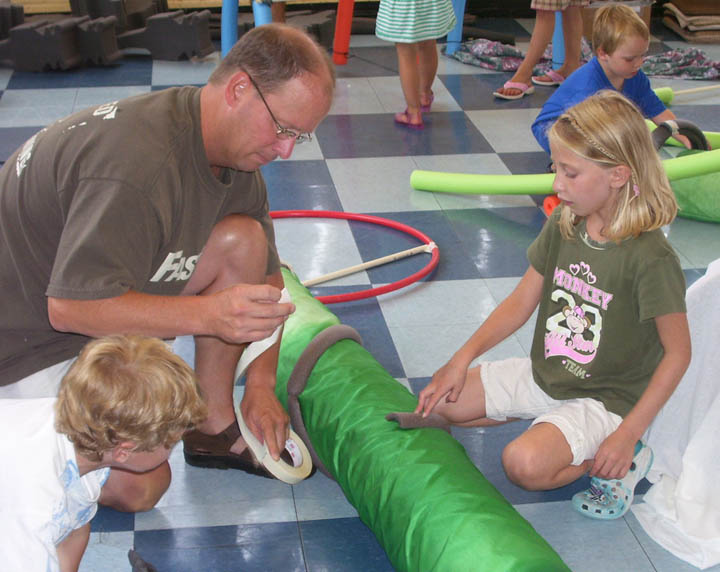
  • Create an obstacle course in your house or backyard, with things to hop or climb over and tunnels to wriggle through.  Or build a fort with sheets, furniture and cardboard boxes.  Or make a mini-golf course with objects found around the house.
  • Have crazy challenge races – playful competitions where the object is to complete a challenge in the shortest time possible.  For example, run to the other side of the room or yard, put on all the clothes in a box and run back.  Make challenges more difficult by running backward or hopping on one leg.
  • Don’t put the beach ball away just yet!  See how long you can keep it bouncing in the air before it hits the ground.  Also find out how many times you can hula hoop or jump rope without stopping.
  • Play balloon volleyball (with or without a net) or make rackets using paper plates and rulers for a game of balloon badminton.  Try each game outside or in a roomy indoor space.
  • Strreeettch!  Stretching feels good and it can be done standing, sitting or lying down.  Start small with wriggling fingers and toes or with simple reaches and twists.  Make sound effects or sing a song to accompany each stretch.
  • Move to the music.  Play several styles and make up different dances.  Or try games of freeze dance or musical chairs.
  • Take a hike!  If it’s close enough, walk to school together instead of driving.
There are more great ways to keep kids moving this fall.  Look for “Let’s Move, Let’s Play!” programs on the calendar plus explore the Museum’s play and learning environments (and learn some fun facts) with a new Let’s Move! physical activity sheet. Here's a selection:


Happy playing!

A version of this article was originally posted on Kidoinfo.

Thursday, March 31, 2011

Play With Your Kids!

This article by Executive Director Janice O'Donnell was also posted on Kidoinfo.

The big idea behind Providence Children’s Museum is that the best kind of learning happens through play. Kids learn all kinds of important things when they follow their own interests, make choices, try things out, solve their own problems, create their own characters and situations – by playing. As an educator, I am a true believer in this approach.

As a parent and grandparent and a friend of parents, grandparents and kids, I am also convinced that play serves an important role in family dynamics. I advocate for playing with your kids – not interfering in their independent play, but taking a playful attitude to parenting whenever you can.
A simple example of what I’m talking about: a few days ago, in the midst of the get up, eat your breakfast, get dressed, we’re going to be late routine, I said to 9-year-old Finn, “Brush your tooth.”
“My tooth?” he said, “Brush my tooth?” and headed off to the bathroom chuckling instead of complaining. It was just a moment of silliness but it softened the nag element. His giggles made me happy and my impatience dissipated. A playful attitude can change everything!

I highly recommend play as a hedge against irritation. You know those recurring trouble spots – fussing about going to bed, picky eating, sibling scuffles – that really frustrate you. Fend them off by getting playful before you get annoyed. Maybe your kid is pokey about getting dressed in the morning. Challenge her to a getting-dressed race and be really goofy about it. Act as if you are hurrying as fast as you can but make silly mistakes (like putting on your jacket inside out) that slow you down so that she wins. When you’re both laughing, it’s really hard to be angry at each other. Let’s face it, the only way you can win a battle of wills with a child is by not engaging in one.


Beyond keeping the peace, playing with your kids lets them know you’re paying attention to them. From their point of view, it can seem that your attention centers on keeping them safe and making sure they wash their hands and do their homework. When you play with them, you let them know you enjoy them and that feels really good – to the kids and to the grown-ups, too.


Parents are busy, but playing with your kids really doesn’t need to take a lot of time. You can fit it in with things you’re doing anyway. A car ride, for example, is the perfect time for singing together. My grandkids and I like songs that let the singers make up verses as they sing. “Down by the bay, where the watermelons grow” is a good one. The kids sing, “Did you ever see a giraffe…” and I rhyme it with something funny, “in a bubble bath!” They lead and I respond to them. We’re as silly as we can be and have a lot of fun.


Kids play all the time, so it’s easy to join them. Say you’re making dinner and your child comes in and roars. “Yikes! A lion!,” you say and, to prevent a lion attack, you give her a green bean. Or you’re sitting in a waiting room and he’s playing with his little cars. Take one and join his game. Vrooom! You can set a place at the table for her imaginary friend and include the figment in the conversation.

Why not play with your kids as often as possible? It makes life easier, it makes everyone happier, it’s good for them, it’s good for you – and it’s FUN!


For more playful tips, check out “Play With Your Kids! A How-To, Why-To Guide for Parents” by Providence Children’s Museum. The booklet was created to inspire families to play and learn together and is available in English and Spanish; click here to learn more about the guide.

Thursday, March 10, 2011

Static Play!

This post was contributed by AmeriCorps Museum Educator Jackie Frole, who works with kids in the Learning Club program.

On a blustery 20-degree day, after pulling my winter hat off my head and watching my hair fly up like the Bride of Frankenstein, I realized that cold weather is good for something…static! Static (cling and shock) occurs because of the build up of electric charge on objects. Lucky for us, static works best when the weather is dry, like during the cold winter months.

I could go on and on about the phenomena of electrons, but instead, here are a few fun indoor static experiments to try at home. These activities have been tested and approved by kids in Learning Clubs, the Museum’s after-school outreach program that leads hands-on science activities for elementary school-age children. These last days of winter are perfect for science exploration while staying indoors and out of the fickle March cold!
Bending Water
Turn a sink faucet on so that it has a light but steady stream of water. Rub a balloon against a piece of wool or on your hair. Hold the balloon close to the stream of water and watch as it bends towards the balloon!

Can Racing
Use tape to create start and finish lines on the floor. Line up empty soda cans on their sides at the start line. Each racer gets a balloon and rubs it on a piece of wool or their hair. Hold the balloon in front of the soda can (no touching!) and watch it roll toward the balloon See how fast you can get your can to roll, or experiment with different size balloons and cans.
Static Sparks
For this experiment you need a small Styrofoam tray and a small aluminum tray (a pie tray or tin foil both work). Rub the Styrofoam tray with a piece of wool or on your hair and place it down on the ground. Pick up the aluminum tray and drop it on top of the Styrofoam tray. Turn off the lights, slowly bring your finger close to the aluminum tray, and watch a small spark jump from the tray to your hand!

Electrified Powder
Gather different types of powders (flour, detergent, salt, pepper, rice, sprinkles, etc.) and lay them out individually. Charge a balloon by rubbing it against a piece of wool or your hair. Then hold the charged part of the balloon an inch above the powders and watch as they fly up and stick to the balloon. Test out other powders and see what works best.