Showing posts with label Imagination Playground. Show all posts

Friday, September 6, 2013

A PlayFULL Summer at the Parks

This spring and summer, the Museum brought unstructured play to Providence parks for a second year, taking Imagination Playground blocks, fort building and other open-ended fun with loose parts to neighborhoods across the city.  Even though the weather wasn’t as cooperative as we’d have liked, we provided creative play experiences for 930 kids and family members, thanks to the support of the Providence Department of Parks and Recreation and the Partnership for Providence Parks.
We saw kids do some pretty incredible things and captured some of our favorite playful moments.

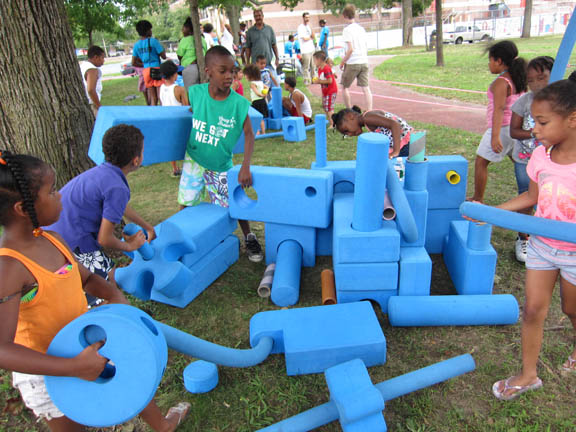
Imagination Playground blocks were a big hit, as always.
This giant structure was a tremendous collaborative effort.
 Adding loose parts created even more opportunities for play.
This grandma and grandson build a steep ramp and took turns rolling and catching balls. Much chasing and giggling ensued!
We also provided wood working with real tools, stick structures with dowels and rubber bands, and Rigamajig – a set of boards, pulleys, wheels, nuts and bolts that inspire creative construction.
This girl spent over two hours thoughtfully building an elaborate house. She draped it with fabric and added a doghouse. Though she welcomed construction help from other kids, when it was time to take it apart, she insisted on doing it ALL by herself.
This family with older kids approached reluctantly, skeptical about playing. But hours later, they were still busy building and rebuilding their house – here dad prepares the curtains!
This tiny teepee was barely built for two!
Cardboard was a hugely popular play material.
This cardboard dwelling – colored inside and out with chalk – had a fabric “carpet” and constantly changing occupants.
This box was occupied by one of its territorial “owners” for well over two hours!
We saw A LOT of inspired fort building with cardboard, dowels, fabric and more.
Forts...
...forts...
and MORE forts!
Thanks to our caped play crusaders and to everyone who played with us this summer!

Monday, July 1, 2013

Play at the Park!

For a second summer, play with the Children's Museum at neighborhood parks across Providence! Stack and create with big blue Imagination Playground blocks, build three-dimensional structures from wooden dowels and fabric, blow bubbles with an array of wacky tools, and discover other open-ended fun with loose parts.

These activities build on the Museum’s efforts to support unstructured, child-directed play throughout the community and are part of our participation in Playful Providence – a citywide celebration of play commemorating Providence’s status as a Playful City for the second year, presented in collaboration with the Partnership for Providence Parks and the Providence Department of Parks and Recreation.


PLAY AT THE PARK 
with Providence Children's Museum!

Wednesday, July 17 • 5:00 - 8:00 PM
Harriet and Sayles Park | Harriet and Sayles Streets
Plus DJs, performers and other activities from 5:30 - 7:30 PM

Thursday, July 18 • 5:30 - 7:30 PM
Dexter Training Grounds | Dexter and Parade Streets
Performance by Jesus Andujar & Grupo Sazon (music from the Spanish Caribbean: salsa, merengue and Latin jazz) from 6:00 - 8:00 PM; salsa dance workshop 6:00 - 6:30 PM

Thursday, July 25 • 5:00 - 8:00 PM
Dexter Training Grounds | Dexter and Parade Streets
Contra dance to fiddle, mandolin and guitar music performed by Rachel Panitch, Andy Grover and Max Newman, with contra dance caller Linda Leslie from 6:00 - 8:00 PM

Friday, August 2 • 5:00 - 8:00 PM
Roger Williams Park | Broad Street entrance
Performance by ECAS (bilingual music, dance and theater) from 3:00 - 7:30 PM

Tuesday, August 6 • 5:00 - 8:00 PM
Fargnoli Park | Jastram and Smith Streets
Performance by Island Farm Bluegrass Band from 6:00 - 7:30 PM

Wednesday, August 7 • 5:00 - 8:00 PM
Brown Street Park | Brown and Creighton Streets
Performance by Smith & Weeden from 5:30 - 7:30 PM

Tuesday, August 13 • 3:00 - 6:00 PM
Burnside Park | Downtown in Kennedy Plaza
Plus the Downtown Farmer's Market and other playful activities with Kidoinfo

Friday, May 31, 2013

PlayWatch: Water Play

This story was shared by Experience Coordinator Meg Sullivan.

During the hustle and bustle of daily life at a children’s museum, it's nice to take a break every now and then and remind myself why I’m here in the first place. Recently in Water Ways, I watched a young girl – about 4 years old – actively engage in in pretend play with “loose parts” that typically have other functions.

One of the many cool aspects of Water Ways is an array of different sized pipe pieces that allow children to construct various fountains, and it's amazing what some kids create. While at first the girl started playing with the fountain parts the “right” way, soon her imagination took hold.

A fountain top first became a cup that contained a hot beverage. She walked around blowing on it and offered some to her father, cautioning him first how hot it was. Then she took some of the little pipe pieces, filled those with water, and poured them back into the large fountain top. As she stirred it with a smaller piece, she muttered to herself about her concoction. Once she tired of pretending it was a beverage, she started using the fountain head in other ways. She emptied it into the waterfall, into the plastic boats, and finally into the water table itself. She stirred her mixture again in the water table with a little pipe piece.


This pretending went on for the full hour I was there and I rather wished I knew what she was picturing. Working at a children’s museum allows me to relive the imagination and wonderment that we all felt as children!

Wednesday, September 5, 2012

Playful Providence!

A Citywide Celebration of Play • September 7 - 9, 2012

The city of Providence was recently honored as a Playful City USA by KaBOOM!, a national non-profit dedicated to saving play for America’s children.  The recognition, which honors cities and towns that make play a priority, was due in part to the Museum’s growing advocacy for children’s free play over the past four years. 

To celebrate this honor and the power of play, the Museum collaborated with the new Partnership for Providence Parks and other partners to plan the first Playful Providence weekend.  It begins on Friday, September 7 with a Playful Providence Kickoff Celebration downtown in Burnside Park from 4:30 - 6:30 PM.  The celebration will feature a host of playful activities – including the Museum’s Imagination Playground – plus lively music and a short presentation by Mayor Angel Taveras, Superintendent of Parks Robert F. McMahon, Museum Executive Director Janice O’Donnell and other speakers.


Playful Providence activities will continue throughout the weekend and will help families discover great places to play across the city.  Events will be held at 21 neighborhood parks and 6 other play and recreation venues and include collaborative art, crafts and games, bubble blowing, music, dance classes and other playful fun. Visit www.providenceparks.org for a full listing of events, including activity details and locations.

Credit: Brown Street Park
In honor of Playful Providence, the Museum's play specialists compiled a toolkit of playful activities, games and resources to share. The toolkit includes some of our favorite fun activities; great games to lead with groups; excellent loose parts for play, including natural and repurposed materials; tips for supporting and encouraging play; and lists of books and websites for more playful ideas. It’s great for parents, teachers, childcare and after-school program staff, and more!  Click here to download the Play Toolkit.

Tuesday, September 4, 2012

A Summer of Play at the Parks

We had a great time taking Imagination Playground and other hands-on fun to Providence city parks this summer, where we engaged 850 kids and family members in unstructured play.  And we saw kids do some pretty amazing things! Staff shared some reflections, favorite moments and observations of the especially creative ways kids used the big blue blocks.

Sarah, AmeriCorps Museum Educator:
Children really remembered Imagination Playground.  When kids from one event showed up at a second event, their excitement was evident:  "I remember these blocks!  This time I'm going to build…!"

I loved watching older children play with younger children.  When something risky was happening such as climbing on a tall stack of blocks or building a bridge to walk across, many times the older children would "safe-proof" the structure before allowing the younger ones to proceed.  It was very sweet.

Alex, AmeriCorps Museum Educator:
It was a blur of happy kids frolicking, whacking, jumping, building and playing. There was a lot of good self-governing. One time, when too many kids tried to fit into a block house, a 4-year-old said, "why don't we try to make it bigger!"

Janice, Executive Director:
One boy (8 or 9) and his friend had a jolly time building for quite awhile and then they invented a new game.  They laid blocks on the ground in a line and walked on them like a bridge. The rule was you could not step on the ground. The last kid had to pick up the last block and pass it forward down the line to the leader who placed it on the ground and everyone moved forward.  The process was repeated over and over, with sometimes great distances between blocks so kids had to really stretch to reach the next one without stepping on the ground. They used the smallest blocks as well as the long ones to create additional step stone challenges.
Other kids joined them.  Eventually almost every kid there was engaged in this game and the line was really long, snaking its way through the previously constructed structures.  All ages played together laughing and cooperating in this game of their own invention.
Megan, Communications Director:
Kids constructed so many wonderful things: a basketball hoop that was used for a lengthy group game, bunk beds and other furniture, a gas station with moveable gas pumps and…
Roller coaster cars
A spa complete with a tanning bed/massage table
An ice cream/lemonade stand
A comfortable combination bed/couch (which the boys decided should be called a "bouch!")
A girl and young boy created an impressive dentist's chair and took turns giving one another a check up.
Two girls used several long curved blocks as the base of a fishing boat and added a stack of wheels to the back to be a fish barrel. Then they made a fishing pole from a noodle and a wheel and headed out to sea!
A group of 7 or 8 kids worked together to build an elaborate car, combining lots of plastic tubes and other loose parts with the blocks. It was a tremendous collaborative effort!
We also brought other activities and loose parts to complement Imagination Playground. Sarah's lively hula hoop games were always a huge hit, and kids constantly invented games of their own.

Monday, September 3, 2012

PlayWatch: Learning Club & Imagination Playground

Three AmeriCorps Museum Educators shared inspiring stories of their Learning Club participants’ creative play with Imagination Playground blocks.

We had the unique opportunity to bring Imagination Playground to the South Side Boys & Girls Club on several occasions and gave kids open-ended challenges to complete as a whole group or in teams. The kids worked together to construct a wall that spanned the room; a house that I could stand in (I am 6’3”), equipped with a seat should I choose to take a load off; and a bridge, 30 feet long, that transported and held the weight of the entire team plus one AmeriCorps member.

Then the kids had plenty of free time to build, which spawned grander and even more thoughtful projects. Three girls, Janiah, Jaziyah and D’Zire, accomplished a truly amazing feat: they constructed a train, with seats for two, which they moved around the room on cylindrical pieces that they took turns placing in front. They discovered this method entirely on their own, and I only assisted with cylinder placement once I noticed their engineering achievement.

The girls had the spatial awareness to know the distance the next cylinder should be placed in order to sustain a smooth ride, and even began angling them to turn the train in a new direction. It was great to see what can happen when our brilliant kids are very much engaged.

– John Rossi


Fox Point Boys & Girls Club came to the Museum for a field trip and we began building an Ice Cream Castle in Imagination Playground.  Alyson, Jhene and I built the walls, while Kimora was busy making ice cream cones out of loose parts and adorning the castle with sugary treats.

Alyson found the laminated sheet with sample structures for inspiration.  In one of the pictures, two curved pieces lean together atop two tall rectangular blocks, making an arched doorway.  Alyson decided that would be my job to create, because I was the tallest one, but I just couldn’t get it to stand!  Frustrated, I told her I didn’t think we could do it, but she wasn’t giving up.  Instead of it being the doorway, she decided to make that the back gate and to have it be closed.  She had me hold the blocks up while she made a tall column underneath to steady them.  Before I knew it, we had an arch.

It might not have been made the way we originally planned, but Alyson was clever enough to come up with an alternate design that still created the shape she desired.  She clearly communicated her ideas and persevered without getting frustrated or giving up.  I was amazed with the way such a small girl who is generally pretty quiet and mild-mannered could perform such high-level science and engineering skills. I told her how impressed I was and suggested she think about becoming an architect one day.  She responded, “I love animals, so maybe I can be an architect for dolphin castles!”

– Meagan Amylon

Imagination Playground inspiration sheet

Learning Club kids who come to Family Nights get a free pass to come to the Museum with their families as often as they want for a whole year, and it's always a pleasure to see them make good use of it. Plus, it's fun for us to get to play again with club alums, and it's flattering to be asked for by name. Such was the case when former Learning Club member Vanessa came to play with her brother and mother.

I met up with them in Imagination Playground and at Vanessa's insistence, we built a car big enough (and functional enough) to actually ride around in (when pushed). As clever and creative as ever, Vanessa added a piece of sparkly black and yellow striped cloth and said, “Check out my flashy taxi!"

She drove her newly-christened vehicle around the room, asking all of the other visitors (kids and adults) if they wanted a ride. "Free rides in the flashy taxi! No fare today." I don't think anyone took her up on it, but within a few minutes there was a competing taxi on the road; her creation was inspiring other kids.

I shouldn't have been surprised at Vanessa's ingenuity and positive impact on the room since that was always the case in Learning Club, but it still impressed me to see a kid so quickly and effectively take charge. Learning Club kids are great Museum-goers and by giving them free passes, we're giving them an opportunity they might not have otherwise. They're also giving us something in return: experienced and enthusiastic Museum visitors who know how to have creative fun.

– Andy Axel

Friday, July 6, 2012

Play at the Park!

Providence Children’s Museum is facilitating a series of “pop-up play” activities at Providence public parks in July and August, taking big blue Imagination Playground blocks plus other loose parts and open-ended fun to neighborhoods across the city. This is a pilot program, in partnership with the Providence Department of Parks and Recreation, to bring unstructured Museum-quality play experiences to public spaces while raising awareness of the importance of play for children’s growth and development.

PLAY AT THE PARK with Providence Children's Museum

Saturday, July 7 • 10:30 AM - 1:30 PM
Algonquin House (Broad Street) – Farmers' Market

Thursday, July 19 • 5:00 - 8:00 PM
Dexter Training Ground (Parade Street) – Farmers’ Market and performance by Boo City (rock, country and soul music)

Wednesday, July 25 • 10:00 AM - Noon
Cabral Park (Wickenden Street in Fox Point)

Wednesday, August 8 • 1:00 - 3:00 PM
Richardson Park (Richardson Street and Prairie Avenue)

Thursday, August 9 • 5:30 - 7:30 PM
Roger Williams Park (Broad Street entrance) – Performance by ECAS Theater (Spanish-language/bilingual music, dance and theater)

Tuesday, August 14 • 11:00 AM - 1:00 PM
Burnside Park (in Kennedy Plaza)

Friday, April 20, 2012

Scenes from Imagination Playground

There’s one word to describe kids in Imagination Playground: BUSY! Well, there are plenty of words, but that’s a first impression – a beehive of activity. Children buzz around doing some serious stacking and positioning to create artful sculptures, forts, cities, tentacled creatures and more.

The blocks naturally inspire collaboration and it’s remarkable to see how easily and fluidly kids of all ages join one another's play, building, reshaping and starting over. Some favorites of the many wonderful moments I've observed:

Siblings, 12 years old and younger, spent an hour building an intricate sculpture with an array of blocks plus fabric, plastic hoops, jump ropes, wooden figures. They carefully placed each piece and continued to add on, welcoming other kids to the play, and their creation ultimately evolved into an elaborate "houseboat."


A young boy building with ramps and tracks – testing, readjusting, trying again. When he finally got everything lined up just right to direct rolling balls where he wanted them, the whole room broke out into applause!

Two older girls used many of the square and rectangular blocks to build a fort with their younger foster siblings. The smaller children gathered parts while their older sisters put them in place. Over time the fort developed into a house, complete with wall-to-wall carpet squares and furniture made of curved and spool-shaped blocks. Then they knocked it all down and used the pieces to create artful seesaws that continued to grow more elaborate, and the older kids gave the younger ones rides.

Credit: Jeff Wager, The Herald News
A girl, about 8 years old, lined up a long row of rectangular blocks – narrow side up – to create a balance beam. She followed its path quickly and confidently, adding more blocks to lengthen the track following each journey. After watching her for a few moments, younger children began to join in, carefully practicing their steps and keeping their balance.


Using many of the other loose parts – plastic tubes, cardboard cones, wooden figures – a boy of about 7 laid out a Boston cityscape, complete with skyscrapers, pedestrians and T stops! He took his engineering and architecture very seriously, careful to replicate his parents’ commute to the city as closely as possible.

Another young architect spent a long, focused period building what he described as an art museum, carefully and deliberately searching for just the right part. He said that he didn’t approach his design with a plan, but it was clear to the observer that he knew the piece he needed when he saw it, and that he had an eye for symmetry and aesthetics.


A gang of four kids – three boys and a girl, ages 9, 10 and 12 – worked on their own creations in close proximity, also with a thoughtful choice of pieces and much time spent. Each was different – one very tall with a mix of angles and curves, one very low – an “amusement park” built from tracks and twisting tubes – and one a pyramid-like stack of squares and rectangles that began to grow a tail of curving blocks. Together, the finished structures looked like the whimsical skyline of an imaginary land – a landscape of sculptures. And then the oldest boy became King Kong and knocked everything down!

– Megan Fischer, Director of Communications


PlayWatch: Engineering Imagination Playground

I noticed a younger boy – Charlie, 6 years old – in the beginning stages of an experiment involving an elevated track he had constructed to send balls down. Starting at a stack four blocks high, he first tried to simply get the ball to reach the end. As the ball periodically sped down the track in a straight line, without veering off, Charlie noticed that there were “no obstacles” preventing the ball from reaching its goal.


Not good enough for this young engineer, Charlie then added a jump, long cylindrical shapes, and block with a hole at the bottom for the ball to fall into. Charlie was determined and had several solutions to his own design. He explained to me that cars oftentimes go through tunnels “to avoid obstacles,” and proceeded to make a tunnel for his ball to pass through in a problem spot. Charlie also explained that if the end of the track had a backboard, like in basketball, the ball could bounce back into the hole with more frequency if it were to overshoot. “At least that is one possibility,” he noted.

What started as a simple experiment to harness gravity and momentum evolved into an exercise of engineering and problem solving, and the atmosphere of Imagination Playground invited Charlie to use his great knowledge of real world solutions to problems that mirrored his own construction problems in Imagination Playground here at the Museum.

– John Rossi, AmeriCorps Museum Educator

Thursday, April 19, 2012

Imagination Playground Impressions

We invited a group of 12 kids, ages 4 to 11, for a sneak preview of Imagination Playground before the grand opening and Museum staff shared their first impressions.

Cathy Saunders, Director of Education: 
After the children were first introduced to the blocks, I was struck by the silence in the room. Silent except for the soft sounds of blocks sliding on the floor or thumping as they were stacked on top of each other. There was an intense focus as the children explored the new materials – turning them, stacking them, seeing which ones fit together and connected. After about 10 minutes, conversations and collaborations started happening.


Janice O’Donnell, Executive Director: 
It only took seconds for the kids to start piling the blocks, seeing what attached to what, forming new structures, engineering complex ramps for balls, negotiating for the shapes they needed to complete their vision. Some snippets of their conversations:

"Lets make stairs. Can I have those to make stairs?"
"Yeah! Stairs!" "We need one more block."
"It's a little wobbly"
"We need to support it."
"Try this one."
"This side is not stable. We don't want someone to step there."
"This works. Hey look - this works fine."

"The bad thing is it's foam so when you put weight on it, it goes down and the wheels come off."
"Can these hold the wheels on?"
"Maybe. Let's try it."

"We're going to do a test. Stand back. Let's test it."
"See what I mean? It interferes with the ball."
"Yeah, it's super slow now."
"Wait! I have an idea. Use this!"
"Oh yeah. That solves it. Whoa!"


Mary Scott Hackman, Early Childhood Programs Coordinator:
A very impressive builder (whose father is a city planner, his mother a mathematician) said he wanted to create a roller coaster and was very specific about the type of blocks he wanted more of, saying, "I need one like this but the curve needs to go in the absolute opposite direction."

On the first public day, the age span at one point was from 2 to 12. The 12 year old was a girl who was involved for nearly an hour. One mother said, "My boy is 9 and when he saw the blocks, his eyes lit up like I have not seen in a while."


Carly Baumann, Education Programs Coordinator: 
Introducing additional loose parts inspired new possibilities with the blocks. Some were used as tools – one boy discovered the ends of noodles fit perfectly snug inside cardboard tubes, which allowed him to extend the noodles in the design of an arch, and also attach either end of a noodle into a circle. Two other children invented their own carnival games – a plastic ring, rope and tubes became a ring toss, with the blocks used to bolster the tube.

Of course the children who were collaborating used language to make plans: "Let's try and make a track!" But I also noticed how much they worked in a flow that didn't need words. The roller coaster took on a life of its own and the children negotiated seamlessly in non-verbal ways that adults don't seem to access as easily with one another.


A child who built a sculpture on his own asked to borrow his mother's phone to document his creation. He took photos from many perspectives – at a distance, high, low, close-ups. What an interesting window into how he saw his own process.

When fabric was introduced, two girls began creating a space they could climb inside together. They began with fabric draped over blocks at four corners, and got inside, heads supporting the fabric: "It's hot in here, actually." They reshaped their tent in three more configurations, each time to create more space for themselves and with a more complex design. They used noodles as crossbars, first set up apart from one another and then strengthened them by intersecting the noodles much like real tent poles.