Showing posts with label creativity. Show all posts

Wednesday, September 30, 2015

Cardboard Challenge!


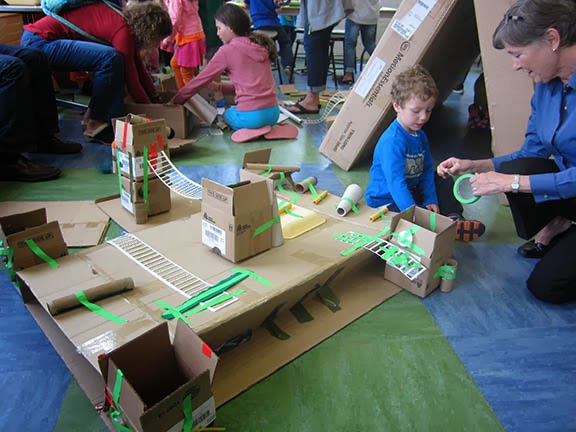
For the third year, the Museum is participating in the Global Cardboard Challenge , an annual worldwide celebration of child creativity and the role of communities in fostering imaginative play, inspired by the incredible story and film Caine's Arcade .

Beginning this weekend – Saturday and Sunday, October 3 & 4 – and continuing Tuesday, October 6 through Monday, October 12, kids and families will design and build original creations using cardboard, recycled materials and their imaginations. Collaborate to invent and construct games, gadgets, robots, rocket ships and much more!

In honor of Cardboard Challenge, we're reposting a favorite story of creative cardboard construction from a past year's event – sort of like our very own Caine's Arcarde!
A mom, dad and their seven kids all busied themselves with their own projects, individually or in teams. Parents and 11-year-old Alvin got to work building a drive-up coffee shop – a tall structure that required dad’s help to attach the roof and stabilize the building. They added a box to serve as the drive-through window and then mom illustrated the storefront. Alvin labored over food preparation, creating delicious donuts and M&M cookies from colorful foam shapes, which he served with coffee in small cardboard cylinders. And “Alvin's Coffee Shop” was born!


After offering free samples to rave reviews, Alvin created a menu to post by the window, took his station, and provided stellar service in a structure that mom was amazed to realized they'd spent over an hour and a half building. Watching this wonderful moment unfold, I was impressed by how Alvin’s parents followed his lead and worked seamlessly together to realize his creative vision.

Megan Fischer, Interim Executive Director

Friday, March 13, 2015

What-a-majig? Rigamajig!

This article, by Museum Interim Director/Communications Director Megan Fischer, was also posted on Kidoinfo.

This month at the Museum, invent creative contraptions with Rigamajig, an intriguing large-scale building kit featuring wooden planks, wheels and pulleys plus rope, nuts and bolts. Conceived by our friend and RISD Industrial Design professor Cas Holman, Rigamajig inspires kids’ imaginative hands-on play, encourages engineering exploration, and cultivates collaborative construction.


Since we first introduced Rigamajig, we’ve seen kids tinker and build with tons of wonderful results, including countless forts, a mobile movie projector, small sleds and larger transport vehicles, and plenty of clever creations that defy definition!

See some great examples in this video of Rigamajig:


One of my favorite Rigamajig moments illustrates perfectly why we offer this activity especially for the Museum’s older visitors. Last summer, when we took Rigamajig out to the Museum’s annual play at the park events, an 11-year-old boy and his 10-year-old sister spent an hour constructing a wide cart, precisely placing each piece. When they were done, the boy pulled his sister a few feet in the cart – and one of the wheels popped off!


The resilient duo regrouped and remedied the dilemma to ensure the rebuilt cart was even better than before. This time, they decided to add a few decorative touches. Choosing from a selection of interesting “loose parts,” they added fabric to pad the seat, long plastic strips to circle the steering column, and some puffballs for good measure! Working together cooperatively and seamlessly, they negotiated the different ideas each sibling introduced and solved engineering and aesthetic challenges to come to an end product they were both quite happy with. Throughout their design project, their mother watched with a smile but gave her focused engineers plenty of time and space to achieve their vision.

Join us to devise your own Rigamajig creations on Tuesdays and Wednesdays, March 17, 18, 24 and 25 from 1:00 to 4:00 PM; check the calendar for future dates and times.

Learn more about Rigamajig:

Wednesday, July 9, 2014

Rigamajig!

New this summer, invent creative contraptions with Rigamajig, an exciting large-scale building kit featuring wooden planks, wheels and pulleys plus rope, nuts and bolts. Conceived by RISD Industrial Design professor Cas Holman (a great friend of the Museum!), Rigamajig inspires kids’ imaginative hands-on play, encourages exploration of engineering, and cultivates collaborative construction.

We’ve seen kids tinker and build with Rigamajig with some wonderful results, including a mobile movie projector, lawnmower and sled, an elaborate home/doghouse, and plenty of inspired creations that defy definition!

See some great examples in this video of Rigamajig, filmed in part at the Museum:
 

Join us to explore Rigamajig most Wednesdays, July through mid-August, from 2:00 - 4:00 PM, and at the Museum’s summer Play at the Park events.

Learn more about Rigamajig: (featuring photos taken at the Museum!)

Rigamajig and other Museum spatial thinking activities are supported by National Grid.

Friday, December 13, 2013

DIY Play

This article, by Museum Executive Director Janice O'Donnell, was also posted on Kidoinfo.

I’ve recently returned from a visit to the UK where I spent a lot of time in “adventure playgrounds.” Not at all common in the US, adventure playgrounds are places where kids build houses and dens with scrap wood and fabric, use old tires for swings or bridges, prop boards to make ramps for bikes and skateboards, and generally create their own play. Back home, describing these places and activities, the people I’m talking with inevitably share their own childhood memories of making playthings out of found objects. They recall making forts out of boards and branches, doll clothes out of fabric scraps, telephones out of tin cans, drums out of oatmeal canisters.

The Land, an adventure playground Janice visited in Wales.
Some of my own most intense play memories involve scavenging and constructing my playthings. I loved gathering up small scraps from my father’s woodworking and incorporating them into environments for my toy animals. I vividly remember a pail filled with tiny ends of wooden pegs that I used to make miniature fences. With the creativity of children, who see the possibilities in all things, shoes became cars for our Ginny dolls to drive and perfume bottles served as fancy lamps on building block tables.

Those were ideas of the moment, suggested by the perceived similarity of one object (an ornate bottle) to another (a glass lamp). There was also, in kid culture, knowledge that passed from child to child. Maybe there still is. When we moved from the country, we copied the suburban kids who clothes-pinned baseball cards to their bicycle wheels. They made a wonderful motorcycle sound as they hit the spokes, rrrrrrrrr. A neighborhood boy showed me how to make a skateboard. We took apart outgrown roller skates and screwed the wheels to boards. I learned to measure, saw and sand making my first skateboard; I learned to measure more carefully making my second one.

We learned a lot more than that. We learned to be resourceful and think creatively. We learned to fail and to try again. We learned about the joy of accomplishment. We learned self-reliance and how to learn from others. Really important lessons that children learn best by doing it themselves.

If you’re thinking of giving a child a fancy new toy or gadget, consider DIY materials instead: woodworking tools, nails and wood scraps; cardboard boxes and tubes and lots of tape; a sewing kit, fabric pieces, buttons and old socks; paints and brushes, markers, and a roll of butcher paper. Give them the gift of making their own play.

Thursday, October 31, 2013

PlayWatch: Magnet Drawing

Spotted at one of our newest exhibit components – the magnetic drawing table in Play Power...

An 8-year-old girl settled in to one of the activity stations and began using the pieces of colorful metal chain to create a grid of perpendicular lines, one vertical and two horizontal.


She formed a circle around their intersection and, as she began adding other details, it became clear that she was creating a figure, carefully adjusting the lines to ensure symmetry.  Explaining that she’d learned the technique in art class, she circled green strands to create an eye on either side of her vertical line.


After completing all of the facial features, she moved her horizontal guides downward, outlined a torso, and added appendages in varying hues.  Her final step was to fill in the torso, deliberately spiraling strands in alternating colors until her masterpiece was complete.


She worked slowly but with tremendous focus and determination, and it was fascinating to see her make a connection to something she’d learned to do with paper and pencil and apply it to a different medium.  Her parents watched from across the room and checked in with her periodically but mostly gave this strategic artist the time and space she needed to carry out her plan and vision.

Megan Fischer, Communications & Marketing Director

Monday, October 28, 2013

Cardboard Challenge, part 2

A young boy (about 6 years old) entered the space and decided that, like many other participants, he was going to build a house – however his plans quickly evolved into constructing a spacecraft. He gave me detailed instructions on how he'd like his door and window cut; there was a definite sense of ownership over the project.
He drew out plans for his steering wheel and column and asked me to cut an impossibly thick tube. When I told him we'd have to use something else he scoured the room and decided that our basket for chalk would be the perfect thing to stand in for the column. He was persistent yet flexible, and it was really interesting to watch him peruse all of the materials available and decide, in the end, that what he really needed was something that we hadn't originally intended as a building supply! Upon completion, the spaceship was fully equipped with a safety sign (that indicated only the pilot should enter), wings and steering wheel. He was ready to fly!
Sarah, AmeriCorps Museum Educator

I observed adults who spent a long time helping and facilitating their children's play. I was happy to see that these grown-ups stepped back when it was time to show off their creations, to let the children explain what they have done and the reason/engineering behind it. For example, an aunt worked with her young niece and nephew to build an elaborate castle. When I asked them about details, the woman did not say a word and let the girl explain that she built the castle for "rainbow fairies, and these fairies were chased by bad guys." The castle included a drawbridge, a dangerous octopus and towers with cannons. When I asked how the cannons work, the boy demonstrated. He placed a ball in a large tube and stuck a smaller tube inside, which caused the ball to shoot out.
Olga, Early Childhood Learning Programs Developer

A girl, about 7 years old, found a sheet of cardboard with pre-cut circles (obviously some packaging leftover).  She inserted a cardboard cone in each of the circular holes and decorated them with ribbon and markers.  She asked if she could take it home as the cones were houses for fairies. She said that she had "a lot of fairies at home" and had made them a village.
Janice, Executive Director

A mom, dad and their 7 kids all busied themselves with their own projects, individually or in teams.  Parents and 11-year-old Alvin got to work building a drive-up coffee shop – a tall structure that required dad’s help to attach the roof and stabilize the building. They added a box to serve as the drive through window, and mom got to work illustrating the storefront.


Alvin himself labored over the food preparation, creating delicious donuts and M & M cookies from colorful foam shapes, which he served with coffee in small cardboard cylinders. And “Alvin's Coffee Shop” was born!

After offering free samples to rave reviews, Alvin created a menu to post by the window. When everything was ready, he took his station and provided stellar service in a structure that mom was amazed to find that they'd spent over an hour and a half building. Upon watching this wonderful moment unfold, I was struck that Alvin’s Coffee Shop might just be our own version of Caine’s Arcade!
Megan, Communications Director

Monday, October 14, 2013

Cardboard Challenge, part 1

Last weekend, we invited kids and families to design and construct original creations using cardboard, recycled materials and their imaginations.  The event was part of Global Cardboard Challenge, the second annual worldwide celebration of child creativity and the role of communities in fostering imaginative play, inspired by the video Caine's Arcade. They created castles, bridges, spaceships and much more!

We saw a lot of intriguing inventions, focused building and some wonderful collaboration.

An 8-year-old boy spent almost 45 minutes building a cannon from a large cylinder – first figuring out how to support it, then adding components like a battery and fuse. He got help from Museum staff and his caregiver when he needed it, with tape and a box cutter, but mostly worked independently and was incredibly focused.

A family of four worked diligently on three different houses! An older brother and sister worked together to create an elaborate structure that included a chimney, a porch with a bed and some pretty fancy hand-drawn wallpaper, while mom built her own red-roofed home.

Meanwhile, across the room, their young cousin claimed a large abandoned house and made it his own by adding a basket of balls to the interior and used lots of tape to form traffic barriers to secure the exterior.

A team of four kids repurposed another house, adding charming details over a period of many hours. When complete, it included tied back velvet curtains, a window box with flowers, a stained glass window, vines crawling over an outside grate, French doors, a comfy bed, a shelf stocked with toys, books and vases, and a security alarm.

A girl, about 8, created an incredible playground diorama, including a basketball hoop, seesaw, slide and trashcan. "I'm going to make the swings at home," she said proudly.

A determined boy spent quite some time constructing the "Providence bridge," thoughtfully finding just the right parts before carefully adding them on.

One of many fabulous castles that emerged throughout the weekend.

We saw lot of great grown-up play – adults playing on their own, supporting their kids’ play without taking over, being helpers and taking directions from their children, and more.

Parents built an impressive sailboat together while their 4-year-old daughter busied herself playing elsewhere.

A dad with two small children stayed for nearly the entire activity on Saturday. First they created the wall of a house, which they colored with chalk and dad embellished with colorful foam shapes. Then they each made their own smaller creations, including train tracks and a house. They had so much fun they came back on Sunday, too!

A mom and dad and their 10-year-old daughter and 6-year-old son, who create a lot of "inventions" at home, split into parent/child teams. The daughter created a cradle for her pet bunny, using loose parts to construct a dangling mobile, while mom decorated the headboard.

A family – mom, grandmom and two boys – created an interesting "factory on a ship that makes electricity."

And that's not nearly all – more stories of creative cardboard constructions will follow!

Monday, July 15, 2013

New in Play Power!

The most recent addition to our Play Power exhibit is an intriguing tabletop activity that invites visitors to use colorful metal chains to create imaginative designs on magnetic easels.  Adults and kids of all ages have been delighted as they “draw” lines and squiggles, form shapes and letters, make patterns and figures – then wipe it clean and start again!

We’re committed to providing a range of activities that promote different types of play and to keeping fresh by frequently changing elements of our exhibits.  This new station enhances the existing Play Power activities with additional opportunities for creativity, artistic expression and tactile exploration.  Visitors can create designs with varying degrees of detail, perfect for engaging older kids and grown-ups.  In the words of a kid tester, it’s “supremely awesome!”

Exhibit intern Cory's chicken creation.
Says Exhibits Director Robin Meisner:
“Visitors sometimes ask where ideas for new exhibits and activities – like this one – come from.  While we develop, design and fabricate our exhibits in-house, we draw on a variety of sources for inspiration, ranging from conversations with visitors and colleagues to our own memories from childhood to other playful environments (including museums).  We first encountered a version of this new activity at Boston’s Museum of Science in an exhibit on making models and loved the way it allows visitors to “draw” and create without consumable materials.

As one of our labels in Water Ways says, “Kids learn from each other.  Other people’s good ideas inspire new ways of thinking.”  We think this applies to people of all ages.”
We’ve certainly witnessed a lot of interesting thinking and designing since the new activity debuted last week…
Museum director Janice O'Donnell created a summer scene...
...alongside artistic grandson Finn.
The table was buzzing with activity, attracting curious onlookers.
Finn's finished masterpiece – his recreation of the well-known painting "American Gothic!"

Monday, September 3, 2012

PlayWatch: Learning Club & Imagination Playground

Three AmeriCorps Museum Educators shared inspiring stories of their Learning Club participants’ creative play with Imagination Playground blocks.

We had the unique opportunity to bring Imagination Playground to the South Side Boys & Girls Club on several occasions and gave kids open-ended challenges to complete as a whole group or in teams. The kids worked together to construct a wall that spanned the room; a house that I could stand in (I am 6’3”), equipped with a seat should I choose to take a load off; and a bridge, 30 feet long, that transported and held the weight of the entire team plus one AmeriCorps member.

Then the kids had plenty of free time to build, which spawned grander and even more thoughtful projects. Three girls, Janiah, Jaziyah and D’Zire, accomplished a truly amazing feat: they constructed a train, with seats for two, which they moved around the room on cylindrical pieces that they took turns placing in front. They discovered this method entirely on their own, and I only assisted with cylinder placement once I noticed their engineering achievement.

The girls had the spatial awareness to know the distance the next cylinder should be placed in order to sustain a smooth ride, and even began angling them to turn the train in a new direction. It was great to see what can happen when our brilliant kids are very much engaged.

– John Rossi


Fox Point Boys & Girls Club came to the Museum for a field trip and we began building an Ice Cream Castle in Imagination Playground.  Alyson, Jhene and I built the walls, while Kimora was busy making ice cream cones out of loose parts and adorning the castle with sugary treats.

Alyson found the laminated sheet with sample structures for inspiration.  In one of the pictures, two curved pieces lean together atop two tall rectangular blocks, making an arched doorway.  Alyson decided that would be my job to create, because I was the tallest one, but I just couldn’t get it to stand!  Frustrated, I told her I didn’t think we could do it, but she wasn’t giving up.  Instead of it being the doorway, she decided to make that the back gate and to have it be closed.  She had me hold the blocks up while she made a tall column underneath to steady them.  Before I knew it, we had an arch.

It might not have been made the way we originally planned, but Alyson was clever enough to come up with an alternate design that still created the shape she desired.  She clearly communicated her ideas and persevered without getting frustrated or giving up.  I was amazed with the way such a small girl who is generally pretty quiet and mild-mannered could perform such high-level science and engineering skills. I told her how impressed I was and suggested she think about becoming an architect one day.  She responded, “I love animals, so maybe I can be an architect for dolphin castles!”

– Meagan Amylon

Imagination Playground inspiration sheet

Learning Club kids who come to Family Nights get a free pass to come to the Museum with their families as often as they want for a whole year, and it's always a pleasure to see them make good use of it. Plus, it's fun for us to get to play again with club alums, and it's flattering to be asked for by name. Such was the case when former Learning Club member Vanessa came to play with her brother and mother.

I met up with them in Imagination Playground and at Vanessa's insistence, we built a car big enough (and functional enough) to actually ride around in (when pushed). As clever and creative as ever, Vanessa added a piece of sparkly black and yellow striped cloth and said, “Check out my flashy taxi!"

She drove her newly-christened vehicle around the room, asking all of the other visitors (kids and adults) if they wanted a ride. "Free rides in the flashy taxi! No fare today." I don't think anyone took her up on it, but within a few minutes there was a competing taxi on the road; her creation was inspiring other kids.

I shouldn't have been surprised at Vanessa's ingenuity and positive impact on the room since that was always the case in Learning Club, but it still impressed me to see a kid so quickly and effectively take charge. Learning Club kids are great Museum-goers and by giving them free passes, we're giving them an opportunity they might not have otherwise. They're also giving us something in return: experienced and enthusiastic Museum visitors who know how to have creative fun.

– Andy Axel

Monday, May 21, 2012

Loosen Up!

This article, by Museum Executive Director Janice O'Donnell, was also posted on Kidoinfo.

In my business we spend a lot of time thinking and talking about loose parts. (We spend a lot of time picking up them up, too.) Loose parts play has certainly been around for as long as childhood, but the term was coined in the early seventies by British architect Simon Nicholson.


Nicholson was decrying an attitude that sees creativity as “…for the gifted few.” The rest of us are expected to passively enjoy the creations of the gifted few but are not considered capable of creating anything ourselves. He claimed that this false, although dominant, idea means the rest of us – and especially children – are deprived of the opportunities and the confidence to play around with variables and components, to experiment and discover – in other words, to be creative. And he was worrying about this 40 years ago – when kids still played outside until the streetlights came on and well before push-button toys and video games.

Nicholson’s Theory of Loose Parts is simple: “In any environment, both the degree of inventiveness and creativity, and the possibility of discovery, are directly proportional to the number and kind of variables in it.”

Think of kids playing at the beach. The variables – the loose parts – are sand, water, mud, pebbles, shells, seaweed, sticks, buckets and shovels, bits of trash, even the sun and surf. And the play is wonderfully creative and inventive. Kids dig holes until they hit water, construct rivers and dams, build a castle and decorate it with mud squiggles, shells and tiny white stones. They attach a ragged beach towel to a stick for a flag. They invent games with waves, bury each other in the sand, and trace each other’s shadows. Even grown-ups get playful in an environment so rich in loose parts.

Nicholson called for schools, playgrounds, childcare facilities and even museums to be more like the beach: open-ended environments filled with loose parts that can be combined and changed and used for many different purposes. (He was writing at the dawn of hands-on children’s museums. I think we met his challenge!)

Kids can easily get the benefits of loose parts play at home. Loose parts are the simplest and least expensive and most malleable of objects – blocks, clay, sand and water, fabric scraps, pots and pans, shoeboxes, cardboard tubes, paper, tape and string. They don’t come with a story – kids create the stories. They don’t have an on and off switch – kids supply the action. There’s no wrong way to use them – kids make the rules. Loose parts play fosters creativity, resourcefulness, and problem solving. Because it’s self-directed and open-ended, it’s more likely to be sustained. It provides the best kind of learning.  


More About Loose Parts Play

Tuesday, May 1, 2012

Unplugged: Celebrating Creativity and Innovation

Last week, we held the Museum’s annual fundraising gala, “Unplugged – The Way to Play.” It was a fun and festive event that celebrated creativity and innovation, and honored seven local innovators who exemplify creative thinking. They shared their reflections on the importance of play – for their own creativity, and at the Children’s Museum.

What were your favorite creative ways to play as a kid, and how did they contribute to your creativity as an adult?

Ava Anderson – Founder/CEO, Ava Anderson Non-Toxic:
Hands down – dress up! Another favorite: fort building with my brother, from snow forts to elaborate pillow and blanket-covered contraptions in our grandmother’s living room.

Barrett Bready – President/CEO, NABsys, Inc.:
I loved interacting with nature, like an exploratory hike through the woods or observing animal life in my favorite stream or a Rhode Island ocean inlet.  I could spend hours collecting rocks or shells.  My career also involves exploring the natural world... just on the nanoscale.

Dennis Littky – Co-Founder/Co-Director, Big Picture Learning and The Met School: My creativity was shown through playing sports and drawing. My parents supported all creative acts that helped me keep being creative throughout my life.

Navyn Salem – Executive Director, Edesia Global Nutrition: My mother never let my younger brother and me watch TV, ever, unless it was Sesame Street at dinnertime. We had to make something up. We made instruments out of the vacuum cleaner; forts out of sheets; telecommunications systems out of string, index cards and clothespins; new living spaces out of the closets; and played Risk and Monopoly for hours.I still love to play games of any kind, like to make my own cards, and detest the racket of the TV unless it is dark out.

Jim Stallman – Owner, M.H. Stallman Co: We used to build forts and make structures in a lot of different ways. We did with sticks and wood what kids are doing [in Imagination Playground] with our foam blocks.


Max Winograd – President/Co-Founder, NuLabel Technologies: I set up a fort with chicken wire and carpeting in my parents' unfinished basement, where my friends and I would take apart electronics and engineer new contraptions. We created our own newspaper during elementary school that eventually became a self-published paper in 5th grade. And my three younger brothers and I invented sports like base-ketball, which involved a basketball and a baseball bat.

Meg Wirth – Founder/CEO, Maternova:
I used to do a lot of strange things like make stews and dyes out of flowers and berries with my best friend. We also performed surgeries on fruit and transplanted the heart (seed) with a bead, inserting Alka seltzer to speed the healing, and spent a lot of time mummifying things. Maybe there is a link between the apple surgery and my interest in health care.  I was definitely encouraged to play outside and to use creativity whenever and wherever.

How do you think the Children's Museum nurtures kids' creativity?

Barrett Bready: I was fortunate to have been introduced to the Children's Museum at a very early age when it was located in Pawtucket – first as a participant and then as a "staff kid," when my mom worked as Director of Development.  I am pleased to see that the concept of "hands-on" learning has been preserved and expanded.

Navyn Salem: My girls and I spent hours at the Children’s Museum when they were little.  I was even a bit teary-eyed when my youngest “graduated” from Littlewoods.  The Museum is an amazing space to escape to. Children have fun and learn something at the same time.  We are lucky to have this treasure in our city.

Max Winograd: The hands-on play at the Children's Museum stretches a child's definition of what's possible. It also reinforces classroom learning in ways far more entrepreneurial and self-driven than a typical elementary school classroom environment. Most importantly, that hands-on play and learning becomes more ingrained than any other method of instruction. I bet children who regularly played at and explored the Children's Museum were found to have – later in life – launched new ventures and emerged as highly creative, innovative adults and leaders.

Learn more about the innovators' and the Museum's creative work in this Unplugged slideshow:

Friday, April 20, 2012

Scenes from Imagination Playground

There’s one word to describe kids in Imagination Playground: BUSY! Well, there are plenty of words, but that’s a first impression – a beehive of activity. Children buzz around doing some serious stacking and positioning to create artful sculptures, forts, cities, tentacled creatures and more.

The blocks naturally inspire collaboration and it’s remarkable to see how easily and fluidly kids of all ages join one another's play, building, reshaping and starting over. Some favorites of the many wonderful moments I've observed:

Siblings, 12 years old and younger, spent an hour building an intricate sculpture with an array of blocks plus fabric, plastic hoops, jump ropes, wooden figures. They carefully placed each piece and continued to add on, welcoming other kids to the play, and their creation ultimately evolved into an elaborate "houseboat."


A young boy building with ramps and tracks – testing, readjusting, trying again. When he finally got everything lined up just right to direct rolling balls where he wanted them, the whole room broke out into applause!

Two older girls used many of the square and rectangular blocks to build a fort with their younger foster siblings. The smaller children gathered parts while their older sisters put them in place. Over time the fort developed into a house, complete with wall-to-wall carpet squares and furniture made of curved and spool-shaped blocks. Then they knocked it all down and used the pieces to create artful seesaws that continued to grow more elaborate, and the older kids gave the younger ones rides.

Credit: Jeff Wager, The Herald News
A girl, about 8 years old, lined up a long row of rectangular blocks – narrow side up – to create a balance beam. She followed its path quickly and confidently, adding more blocks to lengthen the track following each journey. After watching her for a few moments, younger children began to join in, carefully practicing their steps and keeping their balance.


Using many of the other loose parts – plastic tubes, cardboard cones, wooden figures – a boy of about 7 laid out a Boston cityscape, complete with skyscrapers, pedestrians and T stops! He took his engineering and architecture very seriously, careful to replicate his parents’ commute to the city as closely as possible.

Another young architect spent a long, focused period building what he described as an art museum, carefully and deliberately searching for just the right part. He said that he didn’t approach his design with a plan, but it was clear to the observer that he knew the piece he needed when he saw it, and that he had an eye for symmetry and aesthetics.


A gang of four kids – three boys and a girl, ages 9, 10 and 12 – worked on their own creations in close proximity, also with a thoughtful choice of pieces and much time spent. Each was different – one very tall with a mix of angles and curves, one very low – an “amusement park” built from tracks and twisting tubes – and one a pyramid-like stack of squares and rectangles that began to grow a tail of curving blocks. Together, the finished structures looked like the whimsical skyline of an imaginary land – a landscape of sculptures. And then the oldest boy became King Kong and knocked everything down!

– Megan Fischer, Director of Communications