Showing posts with label process. Show all posts

Wednesday, December 28, 2016

Coming to Rhode Island Art

One of the Museum's core values and defining features is the quality and beauty of its learning environments. To enrich visitors’ experience and inspire creative exploration, the new Coming to Rhode Island spaces incorporate the work of these additional outside artists:

  • The photographs on the walls of the Story Center at the end of the time tunnel are by Brown University graduate Lucas Foglia, who lives in San Francisco and whose work has been widely exhibited in the United States, Europe and Asia. All of the photographs were taken in Rhode Island, many at Southside Community Land Trust’s gardens, and strikingly showcase the state’s diversity.

  • The intriguing interactive installation in the Story Center resulted from a collaboration with Pawtucket-based French artist Philippe Lejeune. The sculpture’s reflective surfaces challenge perception and encourage exploration of how something looks from a different and unexpected perspective – a fundamental skill for understanding and engaging with people from different cultures. The installation is part of a larger body of Philippe’s work, called The Glass Project, a group of pieces which are “experiments in transforming the way we see.”
  • The illustrations of John Quigley’s descendant and his brother and him leaving Ireland were drawn by illustrator and former Museum AmeriCorps member Maris Wicks, whose work can be seen in each of the Coming to Rhode Island galleries. To create the illustrations, Maris worked from photographs of John Quigley’s fourth great granddaughter, Margo, and historic images of his hometown in County Kilkenny, Ireland.

Click here to learn about other Museum art works.

Monday, December 5, 2016

Making the Coming to RI Murals

One of the Museum's core values and defining features is the quality and beauty of its learning environments. Throughout its history, the Museum has made a strong commitment to art, commissioning or accepting donations of work from artists – many of them local – to include in exhibits and public spaces. To enrich visitors’ experience and inspire creative exploration, the new Coming to Rhode Island spaces incorporate the work of several outside artists.

The murals and historic figure in the new Fort Adams gallery were painted by Rhode Island artist Harley Bartlett, who is influenced by the late 19th and early 20th century American realist painters and whose work can also be seen in the Coming to Rhode Island Dominican gallery, Fefa’s Market.

Commissioned to depict the people, landscape and seascape at Fort Adams in the early 1800s, the murals extend many of the exhibit’s physical elements to show the Fort’s scale and surroundings. To create the murals, Harley…
  • Visited Fort Adams with the Museum’s exhibits team and Fort staff to select appropriate views to depict in his paintings. 
  • Blended photographs and historic images to create period appropriate concept drawings, and projected these images onto the walls of the Museum’s Fort to figure out scale and placement of objects. 
  • Painted the murals on large pieces of canvas in his studio in Cranston, RI.
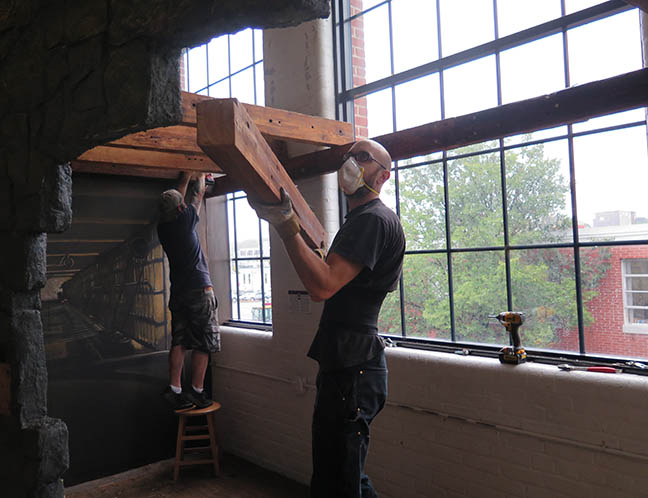
  • Installed the murals onto the Museum’s walls, making adjustments and adding finishing touches once the murals were in place.

Projecting a concept image based on historic images onto the gallery's walls.
One of Harley's projected concept drawings, paired with the subsequent mural in progress.
Mural installation!

The murals add vibrancy and depth to the Fort and surrounding environment, helping to create an immersive space that inspires visitors' imaginative pretend play.

Thursday, November 17, 2016

Coming to RI: Finishing Touches!

The last two weeks have been a whirlwind of activity as we finalize our Coming to Rhode Island exhibit.  Here are some final peeks at the installation process.

Exhibit designer Chris and muralist Harley Bartlett hanging Harley’s incredibly beautiful murals in the Fort Adams gallery – more on the mural process later.


Crew member Mark grinding the cannon created for the Fort gallery in partnership with Cumberland Foundry – more on that later, too!


Chris installing the railing for the Fort’s second level.  It’s very fun to climb the ladders and onto the deck!


RISD student Lisa working on the wheelbarrows for kids to cart foam bricks and stones around the Fort.


Chris installing “story cubes,” one of several activities exploring culture and diversity in the exhibit’s Story Center.  The cubes are particularly important because they share a dozen stories of a variety of real Rhode Islanders who have come to and settled in our state, expanding on the four stories told in the galleries.


Crew member Zach putting the finishing touches on the exhibit’s vibrant entryway.


Graphic designer Valerie mounting photos and labels in the Story Center.


We’re very nearly ready for you, thanks to the months of hard work of the exhibits team and the critical contributions of our many partners.  Come see for yourselves all weekend long, beginning Friday, November 18 at 9:00 AM!

Coming to Rhode Island is supported by The Champlin Foundations; The Children's Workshop Foundation; CollegeBound Saver; June Rockwell Levy Foundation; Murray Family Charitable Foundation; The Providence Journal Charitable Legacy Fund; Rhode Island Council for the Humanities and the National Endowment for the Humanities; The Ryan Family Foundation; and Nancy Smith Worthen, in memory of Margaret L. Worthen (as of November 14).  The Irish gallery was developed in collaboration with The Museum of Newport Irish History and the Fort Adams Trust.

Monday, October 31, 2016

Coming to RI: Bits and Pieces

Making an exhibit involves a TON of work over many months, both big projects and smaller supporting elements. Here’s a look at some of the Coming to Rhode Island details and “loose parts” the exhibit team has worked on along the way.

Crew member Mark and exhibit designer Chris cutting bricks from giant sheets of foam, which kids will use to add to the walls and arches in our replica of Fort Adams.


RISD student Julianna making an array of adorable tools – mallets and trowels – for kids to use in their brickwork.


Exhibit technician Ian painting a pig! Our porcine pal will overlook a small garden plot adjacent to the Fort, where visitors will be able to plant and harvest veggies like carrots and turnips.


Crew member Zach creating frames for an assortment of striking photos that will adorn the walls of the “Story Center.”


Chris building one of several pieces of furniture he has crafted for the exhibit – a field desk for the Fort Adams gallery that will house examples of documents and tools of the trade from the 1800s.


Newly installed flooring in the “Story Center,” in a vibrant palette that complements the freshly painted walls.


And not a small detail by any means, but the finished brick and stonework on our Fort looks absolutely amazing!


With just under two weeks to go until the opening weekend, the exhibit is moving along fast and furiously – check back for finishing touches and background stories.

Coming to Rhode Island is supported by The Children's Workshop Foundation; CollegeBound Saver; June Rockwell Levy Foundation; Murray Family Charitable Foundation; The Providence Journal Charitable Legacy Fund; Rhode Island Council for the Humanities and the National Endowment for the Humanities; The Ryan Family Foundation; and Nancy Smith Worthen, in memory of Margaret L. Worthen (as of October 11).  The Irish gallery was developed in collaboration with The Museum of Newport Irish History and the Fort Adams Trust.

Friday, October 21, 2016

Coming to RI: Building Fort Adams

As we mentioned previously, our replica of Fort Adams for the updated Coming to Rhode Island began long before the exhibit installation started, with a cardboard mockup constructed in the exhibit workshop.


The exhibits team then assembled the entire cardboard version of the fort, to help figure out layout and floor plan.


From there, the fort was constructed in wood and the pieces were stored until it was time to start installation.


After the demolition work was finished, fort installation began!


The crew installed the first and second levels of the fort, then built surrounding walls and second level decking.


After the fort was fully in place, work began on a brick façade, which is being completed as a community project by the apprentice program of the Bricklayers and Allied Craftsmen Union Local 3 MA, ME, NH, RI.


Apprentices in the program learn through practical experience under skilled workers and receive both on the job and in-class training, and the Museum’s project counts toward their training hours. We’re grateful to benefit from their skills to give the fort a more authentic feel, and to be able to provide a valuable training opportunity.


Check back for more stories and photos of reinventing Coming to Rhode Island!

Coming to Rhode Island is supported by The Children's Workshop Foundation; CollegeBound Saver; June Rockwell Levy Foundation; Murray Family Charitable Foundation; The Providence Journal Charitable Legacy Fund; Rhode Island Council for the Humanities and the National Endowment for the Humanities; The Ryan Family Foundation; and Nancy Smith Worthen, in memory of Margaret L. Worthen (as of October 11).  The Irish gallery was developed in collaboration with The Museum of Newport Irish History and the Fort Adams Trust.

Friday, September 30, 2016

Prototyping Coming to Rhode Island

This post was contributed by Museum Exhibits Director Robin Meisner and Research & Evaluation Specialist Suzy Letourneau.

This spring and summer – well before renovations even started – the exhibits team created and tested a range of prototypes to try out some ideas and get feedback on activities, labels and components for the new Coming to Rhode Island spaces. Such mockups – which are often made of scraps of wood, cardboard and tape – help the Museum’s design process by providing insight into how something might be used or interpreted by visitors, how it might look and feel, and how it might ultimately be made.

By prototyping, both in the Museum’s workshop and with visitors in the exhibits, the team is able to create a more thoughtfully developed experience for children and families. Some of the prototypes tested include:

A full-scale cardboard mockup of a section of the replica of Fort Adams!
Through this process, the team explored the layout of the new space, made adjustments for visitor flow and children’s play, and discovered tricks for fabrication of the final wooden fort structure.


A self-portrait drawing activity with prompts to help visitors reflect on what’s important about themselves that can’t be seen.
From this prototype, the team learned that visitors valued both sharing about themselves and reading others’ responses, so they added a portrait gallery to the exhibit. Most visitors wanted to leave their portraits behind for others to see, and one group said that looking at all the portraits was “like seeing the whole community.” Both children and adults thought carefully about what to write about themselves. One parent said, “It took me a minute to think of what was really important about myself, and that was surprising to me.”


A series of labels to help caregivers connect children’s pretend play with their developing social-emotional skills.
Initial prototypes drew on interviews with caregivers about the role of pretend play in children’s ability to empathize and take others’ perspectives. By testing multiple versions of the labels, the team was able to adjust the language and add concrete examples, ultimately helping caregivers find personal connections within the messages. Many caregivers said the labels made them think about how their own children like to pretend in the Museum (and at home), and how children learn to relate to other people, even those who live in a different time or place. One caregiver described the benefits of pretending by saying, “When kids put on those costumes, they really feel how people felt when they wore those clothes and did those jobs.”


Coming to Rhode Island is supported by The Children's Workshop Foundation; CollegeBound Saver; June Rockwell Levy Foundation; Murray Family Charitable Foundation; Rhode Island Council for the Humanities and the National Endowment for the Humanities; The Ryan Family Foundation; and Nancy Smith Worthen, in memory of Margaret L. Worthen (as of September 30). The Irish gallery was developed in collaboration with The Museum of Newport Irish History and the Fort Adams Trust.

Thursday, September 15, 2016

Coming to RI: Renovations are Underway!

Last week we began long-awaited renovations to our time-traveling Coming to Rhode Island exhibit, which will reopen in November. The updates will include:
  • A totally transformed “time tunnel” to guide visitors’ adventure through the story galleries. 
  • A new interactive gallery that shares the story of an Irish immigrant who worked on the construction of Fort Adams. 
  • And a completely reinvented “Story Center” with an array of intriguing new hands-on activities that explore culture and diversity.

While there are a lot of changes in store, the new Irish gallery will replace only the French Canadian mill gallery – so no worries, the beloved English farmhouse, Cape Verdean packet ship and Dominican bodega will return in their current forms!

Before we could begin to install the new exhibit elements, the first step was demolition of the departing time tunnel, Story Center and gallery. Take a look at some scenes from the process!

BEFORE: Members of the exhibits team (Exhibit Developer Jessica Neuwirth, Exhibit Designer & Fabricator Chris Sancomb, Director of Exhibits Robin Meisner) looking like they mean business at the beginning of demo.


Taking apart the Story Center and time tunnel.


Crew members James and Mark disassemble the mill...


...and then the mill house.


The time tunnel and mill, almost fully dismantled.


AFTER: The entryway, nearing the end of demolition. It looks quite different, doesn’t it?!


Stay tuned for more stories and photos of reinventing Coming to Rhode Island.

Thursday, August 6, 2015

Game On!

This spring and summer, Museum visitors have taken a peek at Playful Pastimes in the atrium walkway window boxes – an assortment of silly scenes inspired by familiar games, from Go Fish to Twister, that invite visitors to think about their favorite ways to play. Created by AmeriCorps members Lucia Carroll and Savannah McMullen with guidance from Exhibits Director Robin Meisner and Exhibits Developer Jessica Neuwirth, the boxes are a mix of clever plays on names and visually appealing interpretations of popular games.

Savannah and Lucia's work in progress

On their process… 

Savannah: "Coming up with the games themselves wasn’t hard, it was more about what we could do with each game. We had a couple of misses where we ran into problems – we were planning on doing Candyland for a long time but we couldn’t get the textures right to make it look like candy."

Lucia: "Or even not just being able to think of an idea we felt was as successful or did the other boxes justice. We tried to be strategic about the games that we picked."

Savannah: "It took a lot of sketches to plan out the tiny space. We had to think spatially – how the whole box could be filled, front to back and top to bottom, without being too crowded. We did brainstorms on games and then sketches, and then different sketches and more brainstorms!"

Lucia: "For me, they were consistently in process, always being edited, until the due date. There’s always something more you can add to them, but I had to figure out what was feasible and go from there."


On materials…

Savannah: "It was mostly about what would work to make the game miniature – using astroturf for grass, wine toppers for tiny chairs, benches and thrones made out of popsicle sticks… We were really open to everything and the potential of materials."

Lucia: "I feel pretty proud that we made most of the stuff in the boxes – we made a concerted effort to make our miniatures and use found items."

“It’s fun to see parents and kids looking at them together,” Savannah concluded. “We wanted to make them straightforward enough to figure out but also enjoyable for everyone – something for the kids to look at that also amuse the parents as much as possible.”

They most certainly are – play along over the next few weeks and see many games you can figure out!

Monday, July 6, 2015

Museum Debuts Interactive Sound Sculpture

By Megan Fischer and Robin Meisner

Providence Children’s Museum has designed a vibrant, interactive sound sculpture for Harriet & Sayles Park in South Providence as part of PopUp Providence – an innovative urban place-making program funded by Providence’s Department of Planning + Development that supports temporary and inexpensive artistic and cultural interventions to enliven neighborhoods across the city.  Installed at the park now through August, the sculpture invites kids and adults to explore rhythm and make music on a variety of inventive percussion instruments.

Exhibit Designer Chris Sancomb observes the first kids to test the sculpture.

Children inherently respond to banging on drums and ringing bells – they love making and sharing music.  The Museum-created sound sculpture invites kids of all abilities to play with instruments in their own ways and to create meaningful interactions with music and with each other.  Making music together promotes confidence and social skills, as well as the development of language, mathematical and spatial thinking – and it's just good fun!  By incorporating a variety of intriguing reclaimed objects and new materials, the sculpture offers kids the opportunity to play both usual and unusual instruments.  We hope to inspire children and their caregivers to explore ways that everyday items can be repurposed into something playful, and to encourage kids to explore their interests and express themselves freely.

While some sculpture components were repurposed, others were laser cut or handmade from steel and welded together.

Many people don’t know that we make our own exhibits at Providence Children’s Museum.  One of the defining features of our environments is that they are original creations made by the Museum's professional staff along with additional educators, scholars and artists, which means that most of what you see at the Museum was developed, designed and fabricated in house.  We were excited to go beyond our walls to create the sound sculpture for Harriet & Sayles Park because we have a deep commitment to bringing high-quality play and learning experiences to low-income families across Providence – particularly to the South Providence neighborhood close to the Museum.  Most of our outreach takes the form of programs and activities, and the sound sculpture allows us to offer something new.


Stop by Harriet & Sayles to make some joyful noise this summer!  And if you arrive on a weekday from 11 AM - 2 PM, you’ll also see unstructured, creative play activities guided by Providence PlayCorps, in conjunction with the free federal summer meals program.

See more photos of the music sculpture installation on Facebook.


Friday, March 13, 2015

What-a-majig? Rigamajig!

This article, by Museum Interim Director/Communications Director Megan Fischer, was also posted on Kidoinfo.

This month at the Museum, invent creative contraptions with Rigamajig, an intriguing large-scale building kit featuring wooden planks, wheels and pulleys plus rope, nuts and bolts. Conceived by our friend and RISD Industrial Design professor Cas Holman, Rigamajig inspires kids’ imaginative hands-on play, encourages engineering exploration, and cultivates collaborative construction.


Since we first introduced Rigamajig, we’ve seen kids tinker and build with tons of wonderful results, including countless forts, a mobile movie projector, small sleds and larger transport vehicles, and plenty of clever creations that defy definition!

See some great examples in this video of Rigamajig:


One of my favorite Rigamajig moments illustrates perfectly why we offer this activity especially for the Museum’s older visitors. Last summer, when we took Rigamajig out to the Museum’s annual play at the park events, an 11-year-old boy and his 10-year-old sister spent an hour constructing a wide cart, precisely placing each piece. When they were done, the boy pulled his sister a few feet in the cart – and one of the wheels popped off!


The resilient duo regrouped and remedied the dilemma to ensure the rebuilt cart was even better than before. This time, they decided to add a few decorative touches. Choosing from a selection of interesting “loose parts,” they added fabric to pad the seat, long plastic strips to circle the steering column, and some puffballs for good measure! Working together cooperatively and seamlessly, they negotiated the different ideas each sibling introduced and solved engineering and aesthetic challenges to come to an end product they were both quite happy with. Throughout their design project, their mother watched with a smile but gave her focused engineers plenty of time and space to achieve their vision.

Join us to devise your own Rigamajig creations on Tuesdays and Wednesdays, March 17, 18, 24 and 25 from 1:00 to 4:00 PM; check the calendar for future dates and times.

Learn more about Rigamajig: