Showing posts with label artists. Show all posts

Wednesday, December 28, 2016

Coming to Rhode Island Art

One of the Museum's core values and defining features is the quality and beauty of its learning environments. To enrich visitors’ experience and inspire creative exploration, the new Coming to Rhode Island spaces incorporate the work of these additional outside artists:

  • The photographs on the walls of the Story Center at the end of the time tunnel are by Brown University graduate Lucas Foglia, who lives in San Francisco and whose work has been widely exhibited in the United States, Europe and Asia. All of the photographs were taken in Rhode Island, many at Southside Community Land Trust’s gardens, and strikingly showcase the state’s diversity.

  • The intriguing interactive installation in the Story Center resulted from a collaboration with Pawtucket-based French artist Philippe Lejeune. The sculpture’s reflective surfaces challenge perception and encourage exploration of how something looks from a different and unexpected perspective – a fundamental skill for understanding and engaging with people from different cultures. The installation is part of a larger body of Philippe’s work, called The Glass Project, a group of pieces which are “experiments in transforming the way we see.”
  • The illustrations of John Quigley’s descendant and his brother and him leaving Ireland were drawn by illustrator and former Museum AmeriCorps member Maris Wicks, whose work can be seen in each of the Coming to Rhode Island galleries. To create the illustrations, Maris worked from photographs of John Quigley’s fourth great granddaughter, Margo, and historic images of his hometown in County Kilkenny, Ireland.

Click here to learn about other Museum art works.

Monday, December 5, 2016

Making the Coming to RI Murals

One of the Museum's core values and defining features is the quality and beauty of its learning environments. Throughout its history, the Museum has made a strong commitment to art, commissioning or accepting donations of work from artists – many of them local – to include in exhibits and public spaces. To enrich visitors’ experience and inspire creative exploration, the new Coming to Rhode Island spaces incorporate the work of several outside artists.

The murals and historic figure in the new Fort Adams gallery were painted by Rhode Island artist Harley Bartlett, who is influenced by the late 19th and early 20th century American realist painters and whose work can also be seen in the Coming to Rhode Island Dominican gallery, Fefa’s Market.

Commissioned to depict the people, landscape and seascape at Fort Adams in the early 1800s, the murals extend many of the exhibit’s physical elements to show the Fort’s scale and surroundings. To create the murals, Harley…
  • Visited Fort Adams with the Museum’s exhibits team and Fort staff to select appropriate views to depict in his paintings. 
  • Blended photographs and historic images to create period appropriate concept drawings, and projected these images onto the walls of the Museum’s Fort to figure out scale and placement of objects. 
  • Painted the murals on large pieces of canvas in his studio in Cranston, RI.
  • Installed the murals onto the Museum’s walls, making adjustments and adding finishing touches once the murals were in place.

Projecting a concept image based on historic images onto the gallery's walls.
One of Harley's projected concept drawings, paired with the subsequent mural in progress.
Mural installation!

The murals add vibrancy and depth to the Fort and surrounding environment, helping to create an immersive space that inspires visitors' imaginative pretend play.

Friday, June 3, 2016

On Display: Salley Mavor’s "Wee World"

New in our ThinkSpace exhibit, discover an installation of intricate illustrations in fabric relief collage plus three-dimensional dolls and houses created by artist Salley Mavor of Wee Folk Studio, illustrator of more than a dozen exquisite books.

Credit: Salley Mavor

The ThinkSpace “geometry gallery” features displays of objects that provide different representations of spatial thinking in everyday life and the designed environment.  In creating her illustrations, Salley starts in 2-D with simple sketches and layouts before moving to 3-D to sew and incorporate various materials, including fabrics and natural and handmade objects.  The finished 3-D fabric reliefs are then photographed and printed in her books in 2-D.


From Salley’s website:
“I have had a life-long fascination with little things and needlework and rediscovered my childhood delight in sewing and creating miniature scenes while studying illustration at the Rhode Island School of Design.  Manipulating materials in my hands with a needle and thread was so much more satisfying than rendering with a pencil or brush.  I found that I could communicate my ideas more clearly and that my hands would direct me in a compelling way... I create narrative scenes in relief, much like miniature, shallow stage sets, with figures imposed on embellished fabric backgrounds.  My work is decorative and detailed, full of patterns from nature and found objects, all stitched by hand with a needle and thread.”
Credit: Salley Mavor

The display will be on view through early January, and visitors can also browse one of Salley’s beautiful books nearby – “Pocketful of Posies: A Treasury of Nursery Rhymes.”  Inspired by the installation, families can craft their own fairy houses from natural and found objects on June 4 & 5 and make “pocket fairies” from fabric and other materials on July 7; see our calendar of activities for details.

Though Salley is a Cape Code resident and RISD graduate, this is the first time her incredible work has been displayed in Rhode Island – but it’s not the last!  She also has an exhibit of her needle art at Bristol Art Museum this fall, from September 16 - October 30, 2016.

Learn more about Salley’s work and process on her website, and in this excellent interview.

Friday, March 11, 2016

Art Around the Museum

One of the Museum's core values and defining features is the quality and beauty of its learning environment. With a commitment to art since opening in 1977, the Museum has commissioned or accepted donations of work by artists – many of them local – for our exhibits and public spaces.  These vibrant murals and paintings, intricate sculptures and carvings, and more introduce rich color and texture to every corner of the Museum, inspire creative exploration, and introduce children to art and artists.

Discover these Museum artworks – click below each image to learn more:

Museum Art

Friday, October 30, 2015

Mother Goose in ThinkSpace

The “geometry gallery” in ThinkSpace features changing displays of natural and handcrafted objects that provide strong visual representations of spatial thinking, highlighting shapes in everyday life and the designed environment. Discover the newest installation: scenes from favorite Mother Goose rhymes hand-carved from blocks of wood, complemented by colorful images from picture book illustrations.

The pieces are selections from Hey Diddle Diddle!, a larger display created by Dan Elkins and George Alexandre and previously exhibited in the Museum’s atrium walkway and lobby. Elkins and Alexandre were members of The Splinter Group, a local association of retired craftspeople who were active woodcarvers; Dan Elkins also created the circus carvings in the Museum’s stairwell.


“These wood carvings are a great example of spatial thinking because they involve working from 2-D images or illustrations of nursery rhymes and creating 3-D representations,” said Exhibits Director Robin Meisner. “And carving itself involves taking a simple block of wood, envisioning the final product and using a variety of tools to transform that block into a sculpted piece.”

The carvings will be on display for the next few months – take a peek to see Jack jump over a candlestick, a cow jump over the moon, and more!

Wednesday, April 15, 2015

Unicorns Appear at Providence Children's Museum!

Providence Children’s Museum is part of Unicorns in Residence: Providence, an imaginative, interactive art experience taking place across the city this spring and summer.  Designed by New York artist Camomile Hixon and curated by Helene Miller, the project invites families to join a search for a missing unicorn and spot the mythical creatures in different forms at Providence parks, museums, libraries and other cultural organizations.

For its role in Unicorns in Residence, the Museum hosts several playful components from April 15 - May 15:
  • Step into the “PlayPhone” – a life-sized glittered phone booth – to report a sighting to the missing unicorn hotline.
  • Examine posters and photographs of the missing unicorn at recognizable locations around the world.
  • Listen to recordings shared by others about their enchanted unicorn encounters.
  • See two sparkly unicorn figures that are part of a larger “unicorn stampede,” which was recently on view at Providence Public Library.

Credit Ania Simpson
Inspired by the project, the Museum is also offering accompanying activities exploring mythical creatures.  Decorate unicorn horns and dragon scales, draw with unicorn dust, play a unicorn shoe toss game and more in Discovery Studio most days from April 13 - May 1, and meet the unicorn artist on Friday, April 17 from 5:30 - 7:00 PM; visit our web calendar for details.

To learn more about Unicorns in Residence, visit unicornsinresidence.com.

Tuesday, December 30, 2014

Water Ways: Making the Ceramic Mural

Among the many artful elements of our new Water Ways environment is a stunning ceramic mural handcrafted by Peter Geisser and Mika Seeger, a team of artists and educators who have collaborated for two decades to create ceramic sculpture and mosaics from wood-fired stoneware and porcelain.  This is their fifth major public project together, though they have worked separately on dozens of murals and mosaics.  As a team, they have a particular interest in bringing people together through community-based artworks; past projects include ceramic murals at India Point Park in Providence and Narragansett Town Beach.

Commissioned by the Museum to reflect the color, feel and movement of water, the duo’s abstract Water Ways mural gives Museum visitors a uniquely hands-on experience with art.  In their words, “Water and waves in clay as relief sculpture and represented by tiny mosaic tiles… engage children on a textural journey.”   Peter also spoke about their medium in terms of the murals’ permanence: “With kids, permanence is a wonderful phenomenon.  It gives a sense of belonging and importance.”

Working at Mika’s Tiverton ceramic studio, the two started their process with research, exploring Leonardo DaVinci’s studies of water and photographs of actual water, though they decided they wanted the piece to be more abstract.  They admit that their styles are quite opposite – Peter's strength is the big picture and his work is naturally more abstract while Mika delves into realism and focuses on detail.  “We meet in the middle somewhere,” said Mika, while Peter described their process as “a push and pull.”


Once they had their inspiration, they ripped big paper into pieces and taped it up to create the mural’s initial pattern.  They transferred the template to a large custom-built table topped with plastic, then canvas, then a ½ inch slab of clay, and finally the paper pattern traced at a larger size so they could start building the sculpture.


They added and molded clay to create a massive sculpture, which they completed in a single day to give it a feel of spontaneity. 


Once the entire surface was complete, they let it dry, cut it into pieces, and hollowed out the thicker pieces so they’d fire more quickly.


When all of the pieces were bone dry (completely air dried), Mika and Peter numbered them, did an initial bisque firing in an electric kiln and then glazed them in a unique way.  After Mika painted three white coats, they applied a wax resist over the tips of the waves to create the foam and poured blues over it to fill in most of the body of the waves.


They fired the pieces again – a second 30 hour+ long firing!  When the pieces were fully fired, they filled the hollow backs with a mix of Styrofoam and cement so they would be durable, yet light enough to hang.


They traced around the pieces on paper to create another pattern, which they transferred to the Water Ways wall to guide the installation.


All told, the incredibly intricate sculpture was made from about 500 pounds of wet clay and includes 91 large sculptural pieces, which went up in one day, plus hundreds of handcrafted colorful mosaic tiles in different shapes, which took two weeks to fill in.  Every piece but the small mirrored bits is handmade.


In putting the mosaic together, they tried a new technique for this project: they left some areas of the larger pieces unglazed and brought the mosaic onto the curved ceramic surfaces, which helped create an illusion of different depths and of movement.  The finishing touches included grouting the tiles and cleaning the entire piece.

Reflecting on the project, Peter said, “It’s the only purely abstract mural we’ve ever done,” and added, “If we’re going to do a mural, we want it to be extraordinary.” 

And that it most certainly is!  We’re deeply grateful to Mika and Peter for creating this incredible piece to complement Water Ways and are proud to count it among the Museum’s collection of vibrant works by talented local artists.

Wednesday, July 23, 2014

Blown Glass On Display

The “geometry gallery” in ThinkSpace features changing displays of natural and man-made objects that provide strong visual representations of spatial thinking, highlighting shapes in everyday life and the designed environment. Discover the newest installation by artist Tracy Glover, who is known for her gorgeous glass lighting and decorative accessories. From Tracy’s website
“Her skill is first as expert craftsman, using time-honored Venetian glassblowing techniques. Then there is her color sense: playful, lighthearted, fresh; marrying hues in triplicate for her wonderful a cane striped patterns. She delights in the physicality of the glassmaking process, and the challenge of working with such a malleable, fragile material.”

“Spatial thinking is an intuitive understanding (a sense) of shape and space – it’s about coordinating concepts of shape, representation and reasoning, “ said Exhibits Director Robin Meisner. “The art of glassblowing involves spatial thinking throughout the process: thinking about and transforming shape, color and texture; evaluating and changing size and scale; creating patterns; and more. And the glass beads and their shadows are really lovely to look at!”

The beautiful blown glass beads by Tracy and team will be on view through the end of the year – be sure to take a close look!

Wednesday, December 11, 2013

Museum Art

One of the Museum's defining features is the quality and beauty of its learning environment.  Since opening in 1977, we have commissioned or accepted donations of work by artists – many of them local – for our exhibits and public spaces.  These vibrant murals and paintings, intricate sculptures and carvings, and more contribute to the Museum’s creative aesthetic while introducing children to art and artists.


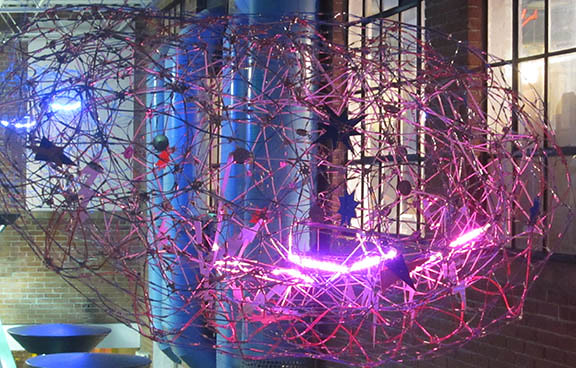
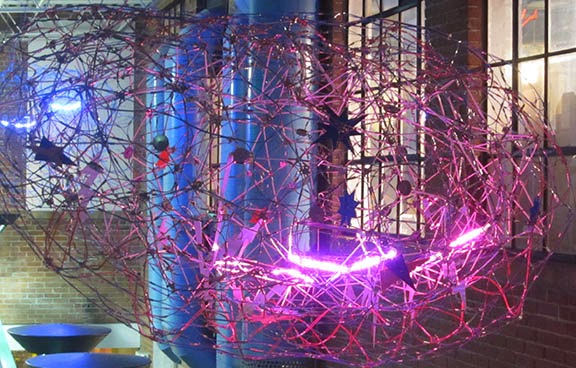
Not long ago, we welcomed new artworks to our atrium walkway.  One is an intriguing sculptural installation commissioned from Providence-based Mid-Ocean Studio, a collaborative team of artists who create public art projects internationally. Their first work in Providence, Space Debris responds to and expands on the idea of shapes in space as explored in our ThinkSpace exhibit.

The piece consists of three cloud-like structures with embedded images that refer to geometric concepts; windows overlooking the atrium allow interaction between sculpture and playspace.  Mid-Ocean Artistic Director Brower Hatcher called the creations “experiments with geometric systems” and described the design process as “three-dimensional weaving” and “my own kind of play.”


Hanging nearby are four ceramic murals loaned to the Museum by Massachusetts- based artist Judith Inglese, who has designed and fabricated work for public spaces for over 25 years.  A grandmother who has visited the Museum with her family, Judith “particularly enjoys depicting the role of creativity, imagination and discovery in the life of the child, as well as the importance of cross-cultural exchange and community.”

Her panels represent music, dance, opera and theater, each created in bas-relief and featuring whimsically detailed images and a variety of vibrant glazes that encourage visitors’ visual and tactile engagement.

Click here to view a slideshow with more Museum artwork.

Monday, March 26, 2012

Word Play

Children’s Museum visitors will also discover Word Play, another exciting new display in the atrium walkway window boxes. Created by artist Lee Singer of Wakefield, RI, charming clay critters in clever scenes convey funny puns and idioms. Families delight in finding a bowling fish (“fishbowl”), a bathing pig (“hogwash”), a spelling bee and more.


The exhibit unites two hobbies Singer has enjoyed since the age of 9: word play and clay play. She crafted an array of creatures from polymer clay, a material she has worked with for 25 years, and selected the most visual options for display – the ones she thought would be the most fun for kids and adults to decipher together.


To create environments for her creatures, Singer relied on a variety of techniques. Some scenes include polymer miniatures, some are hand drawn or use handmade papers, and many incorporate recycled materials from her collection of scraps and leftovers. Singer’s partner – woodworker Adam Levinson – also fabricated some of the tiny props.


Describing her inspiration for the critters and scenes, Singer cited author and illustrator Edward Gorey and her 4th grade teacher, who encouraged her to figure out and draw plays on words.

Singer’s favorite scene is kitty litter – some very messy cats surrounded by their garbage!

Singer, an ER/trauma nurse at South County hospital, crafts a number of other items from polymer clay, including jewelry, beads, ornaments and knitting needle finials. She has displayed her work at various craft shows but this is her first museum exhibit.

Check out Word Play, on view through mid-June, and see if you can puzzle out the puns!

Friday, February 4, 2011

The Carousel is BACK!

Longtime friends of the Museum will remember our colorful carousel, which has been out of commission for a while because, like all well-loved Children’s Museum components, sometimes they need a little extra care! Young children especially have always been drawn to the cheerful music as the carousel rotates to reveal some unexpected creatures. So we’re thrilled to have it back and in its new location, right in the lobby, where we know it will once again get a lot of attention.

In honor of the carousel’s reappearance, here’s a blast from the past: an article announcing the carousel’s arrival in the Museum’s January/February 2000 newsletter!

Local Group Carves Out New Exhibit
Gnomes, bears, birds and clowns abound as the Museum host
s a fascinating exhibit of wood carvings done by a local circle of friends who call themselves “The Splinter Group.” The nine men in the group meet every week in a Bristol basement to carve intricate and charming figures from wood. The best examples of these carvings have been brought together and are on display at the Museum.

One of the most whimsical creations in the exhibit is a colorful carousel that six members of the Splinter Group made and donated to the Museum [in summer 1999]. The working carousel is accurate down to the last detail: it has tiny horses that move up and down, a popcorn stand with real popcorn and a brightly striped cloth canopy on top. “Even the music that plays as the carousel rotates is a recording of the Looff Carousel in East Providence,” explained Dan Elkins, Splinter Group secretary and long-standing member...
Hand-carved animals and exotic animals prance around the
Museum’s model carousel, a gift of the Splinter Group.

Check out more of Dan Elkins’s carvings in the circus case in the stairwell. And look for more information about the many artists whose work is featured in the Museum in future posts. What artist or artwork do YOU most want to know about?
Related posts:
The Story of Estrella
Puppet Masters!
(About our marionette collection - look for a new display coming next month!)

Friday, January 21, 2011

Junk Music!

Last weekend, RISD junior Max Frieder brought an incredible infusion of creative experiences to the Museum’s Paint Play program. Visitors made some joyful noise as they grabbed drumsticks and explored the sounds of Max’s colorful “Foundstrument Soundstrument,” an interactive percussive sculpture created from a motley mixture of found materials and reclaimed junk.

A project developed over a series of four RISD courses, Max describes the Foundstrument as a wonderful interactive teaching tool that “makes sounds of all kinds, from bops of plastic pipes, to chimes of casted glass, to the bing of reverbarating metal. The different scales have different tones, and there are objects on it of all different kinds of mediums.”

As children explored the beat, Max also led them in a collaborative mural-making activity, while Museum play guides facilitated a printing activity with a vibrant array of paints. Check it out:


Museum staff and AmeriCorps members shared some of their observations and impressions of the program’s magical sights and playful sounds:

To the soundtrack of banging, binging and tapping filling the air, a mom and her son's faces both lit up with smiles – he engaged in painting the background of the mural with an array of colors and moving with his whole body across the floor, she engaged in watching him. I loved what she said to me: “I feel so stimulated right now!”

A group of older boys were painting, playing music, and hanging out with Max, learning more about the making of the Foundstrument. Max told that them that, as an art student, THIS was his homework. Four pairs of eyes widened and the boys said in unison, “Awesome!”

On Sunday, Max invited a friend of his who works with ¡CityArts! – a musician and experiences percussionist – to play on the Foundstrument with visitors. It brought a new dimension to the music to have her sustain an inspiring bold beat while kids and grown-ups began adding their own rhythms, fleshing out the sound and morphing it. It was like a junk drum circle, but you weren't limited to one “drum,” you could change the instrument as you went along. And two of Max's Big Nazo friends came as their creature alter-egos!

–Carly, Program Developer
Kids were shocked when they were handed a stick and told to go at it and then Mom or Dad joined in, too! “This one makes a cool sound,” said a 10-year-old girl as we banged and made rhythms on a tin kettle, wooden cylinders, and old plastic toys that were drilled into a wheel barrel. Experimenting with different sounds and trying to join in the beat with the artists was my favorite part. I felt that I was making something with children that was purely original that would never be repeated or heard again.
–Kerrie, AmeriCorps Museum Educator

The thing that really stuck with me was the kids’ faces when they saw the Foundstrument – it was a look of wonderment and shock. Some kids weren't sure if they could really hit everything with the drumsticks and others just jumped right in and encouraged the shy kids. It was great! The painting activity went along with it really well because it was two very creative, unstructured experiences in the same place.
–Lyndsey, AmeriCorps Museum Educator

Two children made the biggest impression on me. One young artist, about 7 years old, was playing in front of the funhouse mirrors – she and her mom with their hands full of her beautiful paintings. It was clear how hard she had worked as she told me the paintings’ descriptive names and about her inspiration. And 6-year-old Ethan explored the Foundstrument so seriously, testing all of the parts and sounds, moving to the beat, and breaking out into infectious laughter as he discovered some of its funny details – like a set of plastic teacups and a pair of roller skates. Next, Ethan moved to the painting activities, focusing intently as his bold patterns emerged. It was truly inspiring to see children – and Max! – so engaged in various forms of creative expression, and that the Museum was the setting for this multisensory adventure.
–Megan, Communications Director

Tuesday, October 5, 2010

Step Into a “Small Town”

We’re thrilled to have an incredible new exhibit in the Museum’s atrium walkway window boxes: I Live in a Small Town, created by local artist Megan Jeffery. In 17 playful scenes, the exhibit gives visitors a glimpse into the lives of the town’s inhabitants – a total of 36 handcrafted finger puppet residents and hundreds of intricately detailed miniatures.

Megan, a RISD alumna, has been a children's illustrator for over 20 years, specializing in educational material. When asked to describe the exhibit, she said:
“The BIG idea is…little! Ever since I was a kid, I've collected and made miniatures, and even had a “town” (called “Beetlegrass,” which is now the name of my blog) that lived on top of my dresser. This exhibit features my finger puppet characters that I make by hand using wool roving, fabrics, and other materials. Also on display are the miniatures that I make and that I've collected over the years – some I've had since childhood!”
Each of the scenes is infused with Megan’s own brand of humor. You’re not going to believe your eyes when you see the array of goodies guarded by the butcher and baker in their shops; the musically inclined cow and sheep playing their instruments; decked out disco robots; crabs constructing an elaborate sand castle; and the gathering of G.I. gnomes. And the details! From diminutive dog bones at a festive canine celebration to a tank of tiny fish in the “Nature Nook” to the construction workers’ picture perfect roadway scene, there’s so much to discover.

All of the puppets have a distinct look and personality. From Megan’s blog:
“It's this aspect of making characters that I just love: I start off with a basic idea of how they'll look, but then the puppet starts "telling" me about who he/she is, and he wants to wear, etc. It's this balance of planning ahead AND allowing room for being spontaneous that to me is PLAY.”
We couldn’t have said it any better. We know that kids and adults will LOVE this exhibit, which is on display for the next 4 months.

Get a behind-the-scenes look at Megan’s fascinating and amazingly detailed process in a series of posts on her blog. Here’s a selection:

Thanks to Megan for sharing her work with us again; click here to learn about her previous puppet exhibit at the Museum. Also check out 9 to 5, our newest marionette display.

And leave a comment to let us know which is your favorite finger puppet scene!

Friday, July 23, 2010

Making a Mural

This post was contributed by AmeriCorps Museum Educator Kerrie Hoban, a member of a team serving in the greater Providence Head Start centers operated by Children's Friend.

Providence Children’s Museum does educational outreach to low-income children and families through its AmeriCorps program and our AmeriCorps members also have the opportunity to do their own independent outreach projects.

For my independent project, I recently painted a mural on the bottom floor of Cianci Head Start preschool. The opportunity came at a point in the year when I was thinking a lot about how important art making is to children in encouraging them to feel like strong individuals.

Noticing that some of the walls of Cianci Head Start center were more notably decorated than others, I brought my ideas about painting a mural to Kim Pettaway (head teacher). She loved the drawings I showed her, inspired by the children’s book “I Am An Artist” by Pat Lowery Collins, and we talked a lot about community and how important that is to the families at Head Start. When I shared my idea for the theme of the mural, which is to encourage children and families to feel powerful when they are a part of the world (their community), she immediately told me to get to work!
Excited and armed with a brush and some drawings, I began painting the blank walls. The staff at the center was very supportive and excited and brought me water and materials when I didn’t even ask. The teachers seemed happy to have a new face in the building doing something for the children and families, even for a short while. Ultimately the best moments were the kids’ reactions of awe and surprise as they saw the wall come to life with each passing day. As groups of 3 and 4 year olds passed through the hallways to go to the playground they used their hands to mimic the image they saw, traced letters on the wall, and made observations like “that looks like me”!