
Showing posts with label social service. Show all posts
Showing posts with label social service. Show all posts
Friday, July 31, 2015
Museum Videos
Check out two new videos illustrating the Museum's impact and service and the work of our nationally recognized Families Together program!


Friday, February 15, 2013
Happy Birthday, Nina's House!
One year ago today, Families Together – the Museum's renowned program for court-separated families – celebrated the opening of Nina’s House, a healing, homelike environment where families can rebuild relationships while practicing everyday skills.
While families in need of special guidance continue to play and learn together at the Museum, Nina's House enables Families Together to expand its reach to serve more families, assess their strengths and challenges, and better help them with their specific needs – including parenting skill development for families with very young children and those with mental health and cognitive issues.
In addition to opening Nina’s House, Families Together achieved these 2012 milestones:

While families in need of special guidance continue to play and learn together at the Museum, Nina's House enables Families Together to expand its reach to serve more families, assess their strengths and challenges, and better help them with their specific needs – including parenting skill development for families with very young children and those with mental health and cognitive issues.
In addition to opening Nina’s House, Families Together achieved these 2012 milestones:
- Celebrated its 20th anniversary!
- Served a record 609 children and parents in 233 families
- Welcomed 466 family visits to Nina’s House (a combination of visits guided by Families Together clinicians and visits facilitated by social workers from RI’s Department of Children, Youth and Families)
- Was included in the Congressional Caucus on Foster Youth’s Nationwide Listening Tour examining innovative child welfare practices
- Completed work on a three-year federal grant to establish permanent homes for foster children by drawing on extended family support networks, as part of a coalition of RI social service agencies

Wednesday, February 15, 2012
PlayWatch: Bringing Families Together
Today we’re celebrating the 20th anniversary of our Families Together program and its expansion to Nina’s House, which will allow the Museum to serve more court-separated families, and those with greater challenges. Here are stories from two of the Families Together clinicians that show the impact of the program’s innovative therapeutic visitation, and the types of healing, relationship-building experiences that families will now have at Nina’s House as well as at the Museum.

A mom entering the Families Together program spoke about her childhood and never being able to play or “be a kid.” One of her goals was to learn to have fun with her children and help “make learning fun” for them.
– Shannon Doherty, Families Together Visitation Specialist

Click here for another powerful story about a family's growth and healing, shared by Families Together Clinician Amanda Grandchamp.

A mom entering the Families Together program spoke about her childhood and never being able to play or “be a kid.” One of her goals was to learn to have fun with her children and help “make learning fun” for them.
In Shape Space, her 3-year-old daughter created a “ship” and showed it to us with a huge smile. Mom corrected her, saying the shape was really a pyramid. Her daughter stood her ground and declared, “No, I made a ship!” I could see that mom’s goal to have fun might be a challenge to accomplish.
During visits, I modeled playing and pointed out the ways her daughter responded, letting mom practice. Her daughter was engaging and had an active imagination, even though mom had not encouraged this in her. As mom became more comfortable at the Museum and with me, she learned about different ways to play, imagine, and most of all be silly. She learned a lot of this from her daughter.
Over time, mom reported that she was playing more at home and incorporating play into her daily routine. She even squirted her daughter with water and had a “water war” while washing dishes! Mom found that her relationship with her daughter improved and issues like managing tantrums were easier when she had a balance of fun and serious in each day.
In the end, the 3-year-old had made learning fun for mom!

In Families Together, we are privileged to witness firsthand just how powerful play can be.
A young mother and her 2 ½-year-old son have weekly visits at the Museum, the only time during the week that they see each other. They are rebuilding their relationship after months of separation.
At our first visit, the mother appears unsure of herself and the interactions between mother and son are tentative. The child calls his mother by her first name, acts shy and resists affection, not even wanting to hold hands. They play together for an hour, the mother following her son’s lead.
By visit six, the little boy sees his mother as a playmate, but not “Mommy.” They play throughout the Museum, smiling and laughing, no longer tentative.
By visit 14, the child runs to his mother, greeting her with a hug. He initiates play with her and says, “I love you” at the end of the visit.
By visit 18, their last with Families Together, the mother is almost always “Mommy.” She’s confident and clearly the parent, not just a playmate. Her son willingly holds her hand and asks to be held. They are mother and son again.
This is the power of play.
– Amber Massed, Families Together Clinician
 | ||
| Illustrations by Valerie Haggerty-Silva, Museum graphic designer. |
Click here for another powerful story about a family's growth and healing, shared by Families Together Clinician Amanda Grandchamp.
Tuesday, February 14, 2012
Celebrating Nina’s House

As we announced last fall, Families Together – the Museum’s renowned social service program – is growing! Tomorrow, after 20 years of bringing court-separated families together, the Museum opens Nina’s House, a homelike setting for family healing.
Created by Providence Children’s Museum in collaboration with the RI Department of Children, Youth and Families (DCYF) in 1992, Families Together provides therapeutic visitation and permanency planning for children in foster care and their families.
When the state steps in to remove children from their parents’ care because of abuse or neglect, the usual goal is to reunite the family. While parents are helped to acquire the skills and resources they need to care for their children, the children live in foster care. It is critical that children and parents have regular high-quality contact while living separately. Families Together participants – children ages 1 to 11, their parents, and often extended family members – work with the program’s family therapists to rebuild relationships and strengthen parenting skills. During visits, the therapists assess the family’s strengths and challenges and help develop a permanency plan so their lives won’t be disrupted again.

For 20 years, DCYF-involved families in need of special guidance have rebuilt relationships while engaging in healthy play activities at Providence Children’s Museum – a nurturing and inspiring environment for fostering positive parent-child interaction for all families, especially those at risk. Since its inception Families Together has helped more than 2,000 families. In 2011, the program served 500 children and parents in 180 families.

With the addition of Nina's House, a Providence home purchased and renovated by The Nina Foundation, families will also strengthen relationships and communication while practicing basic skills in a warm, homelike setting conducive to family healing. Nina’s House will enable Families Together to expand clinical services to serve more families and better meet their specific needs; fill a major need for early and thorough assessment of DCYF-involved families; provide parenting skill development for more families with very young children; and better serve those with serious emotional and cognitive challenges.

We’re grateful to The Nina Foundation as well as to Ocean State Charities Trust, Admirals Bank, Creative Office Environments, and to 50 individuals who contributed cash gifts, toys and household items to the Nina's House shower. Thank you for supporting children in foster care and their families as they strengthen their relationships and work toward permanency.

Learn more about Families Together in this Museum newsletter and in an interview with program director Heidi Brinig.
Wednesday, April 6, 2011
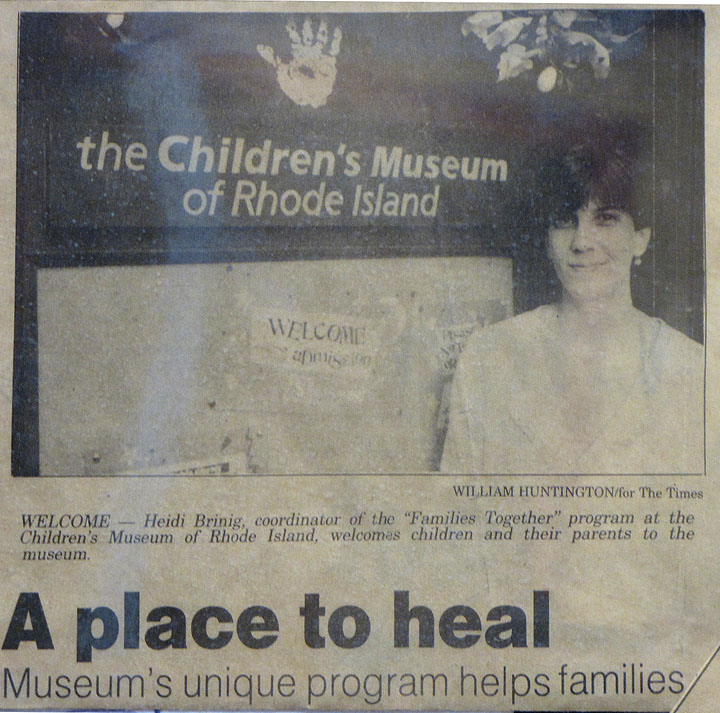
An Interview with Heidi Brinig
 This year, the Museum celebrates the 20th anniversary of Families Together, its therapeutic visitation program for court-separated families. Heidi Brinig, the program's director, came to the Museum as a volunteer in April 1991, working to launch the renowned program. She spoke about her inspiration and the program’s evolution.
What’s your background?
I have a bachelor’s in early childhood education and a master’s degree in human development and family counseling. I previously worked as a community mental health therapist, for a teaching hospital in Pennsylvania. My work was focused around children in foster care and mentally challenged adults. I was also working on a certification in play therapy, how to use play in a very clinical setting.
What was your inspiration for Families Together?
As a therapist, we spent all this time with kids, teaching them better coping practices, but we weren’t teaching the parents anything. We returned kids to families who were unprepared. The system didn’t help me understand the needs of the family and how to support them – and why they came back into the foster system so quickly. I didn’t believe it was helping people – they needed a better way to heal.
 How did the program start?
With work in play therapy and early childhood education, and as a hands-on learner myself, I was fascinated by children’s museums. I went to Boston Children’s Museum and it was the coolest thing I’d ever seen. To see kids’ learning process and joy just does something for my soul.
In the spring of 1990, I researched cities with children’s museums across the country to see if I could develop an internship. Rhode Island was my third phone call, and I was invited to visit to talk about the idea further. The Museum had already been thinking about engaging the social service community more formally, so by late fall they said, okay, we’ll do it. They offered me an internship researching the needs of the social service community and how the Museum could be helpful.
Family and friends questioned how I could go to a place where I knew no one and I thought, what an adventure! I was so taken by the care and the love that people at the Museum had for children and their welfare.
What were the early challenges in starting the program?
Working with DCYF to identify what the program should look like, I had to do lot of research on something that didn’t exist – there was very little written on visitation at that time.
I had to engage the Museum community in a way that supported the families. The staff was on board but I wanted them to invest in the idea, to embrace these complicated people and challenged families.
I believe the line between where I stand in life and where these families stand is very thin. Any one of us could easily be in a situation where we need help. These families’ challenges touch so much of what the Museum as an institution wants to change. Everyone can come here and be the same. We fight for social justice.
 What about today?
Ever since I started this project, it’s been a balancing act on so many levels. The needs of the family – and not victimizing them. Understanding my strengths and limitations. At every stage, being mindful of the needs and mission of the Museum, DCYF, the court and the various levels of the child welfare system. That was challenging as the program was designed and grew and still is every day.
It’s a constant challenge to raise money and do the best we can for these families. There’s a limited amount of money and funding is changing.
Society has a desire to protect children but also respects parents' rights and privacy. Our biggest challenge is respecting the right of parents and helping those that make decisions about their lives. To protect children physically and emotionally and to actually raise them are different challenges, and there are parents who try so hard but just can’t do it. It’s emotionally taxing for Families Together staff and caseworkers.
What are you proudest of?
I’m proud of Providence Children’s Museum for saying yes, of all the individuals who stand and stood by me in this institution and those connected with it – funders, board, staff, DCYF – who agreed to take this risk and continue to do it every day. Of their passion and commitment to do what’s right and be respectful of deserving families.
We’ve taken visitation beyond the Museum and have elevated it to an opportunity for teaching, guiding and assessment– and not just for the immediate family. I like to think we’ve set the pace for other visitation programs, that we’re a model for other child welfare systems and museums. We’ve tried to raise awareness about the value of visitation and over 20 years, I think we’ve succeeded.
 Families Together staff, left to right: Front – Amber Massed, Cheryl Lepre, Jessica Lima;
Middle – Mary Luz Arias, Paula Toland, Heidi Brinig, Cat McCaffery;
Back – Shannon Doherty and Amanda Grandchamp
Back – Shannon Doherty and Amanda Grandchamp
Learn more about Families Together in the spring issue of the Museum's newsletter.
Subscribe to:
Posts (Atom)