Showing posts with label loose parts. Show all posts

Wednesday, October 7, 2015

THE LAND: A Film and Conversation About Risk and Adventure Play


Providence Children’s Museum and Providence Children’s Film Festival proudly partner to present the Providence premiere of “The Land” – a powerful 2015 documentary short film about the nature of play and risk – at the Museum on Thursday, October 22 from 6:30 - 8:00 PM.

The film is set in The Land, a Welsh adventure playground where children climb trees, light fires and use hammers and nails.  It’s a playspace rooted in the belief that kids are empowered and understand their own capabilities and limits when they learn to manage risks on their own.  The film has attracted national attention after being featured in a number of recent articles including “The Overprotected Kid” a provocative piece in The Atlantic by Hanna Rosin that provides a look at adventure playgrounds and how “a preoccupation with safety has stripped childhood of independence, risk taking, and discovery – without making it safer.”

Credit Hanna Rosin
Following the screening, join a lively conversation about the film, adventure play and the benefits of risk to kids’ physical and emotional development.  Discuss ways to foster healthy risk-taking in kids’ play, and how to provide kids with opportunities for adventure play with panelists Erin Davis, “The Land” filmmaker; Michele Meek, filmmaker and educator; and Janice O’Donnell, Providence PlayCorps director and former Children's Museum director.

The screening and conversation are part of the Museum’s commitment to advocate for and raise awareness about the critical importance of self-directed play for children’s healthy growth and development.

The event is free and open to the public, but space is limited – click here to RSVP.

See the trailer, and click here to learn more about the film:


Also check out these recent articles about adventure play and the importance of risk to children's development:
  • Where The Wild Things Play  Adventure playgrounds may look like junk piles but offer kids tremendous opportunities for free, unstructured play. (NPR)

Wednesday, September 30, 2015

Cardboard Challenge!


For the third year, the Museum is participating in the Global Cardboard Challenge , an annual worldwide celebration of child creativity and the role of communities in fostering imaginative play, inspired by the incredible story and film Caine's Arcade .

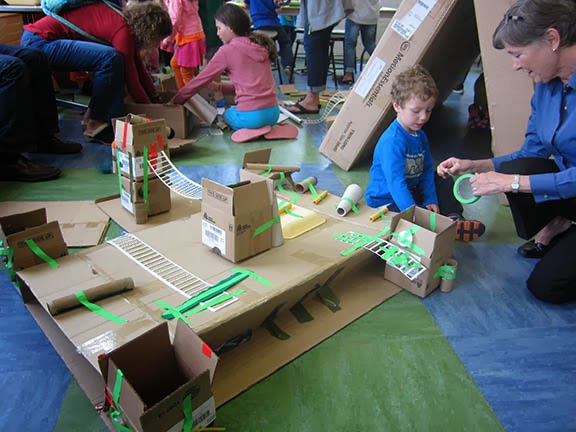
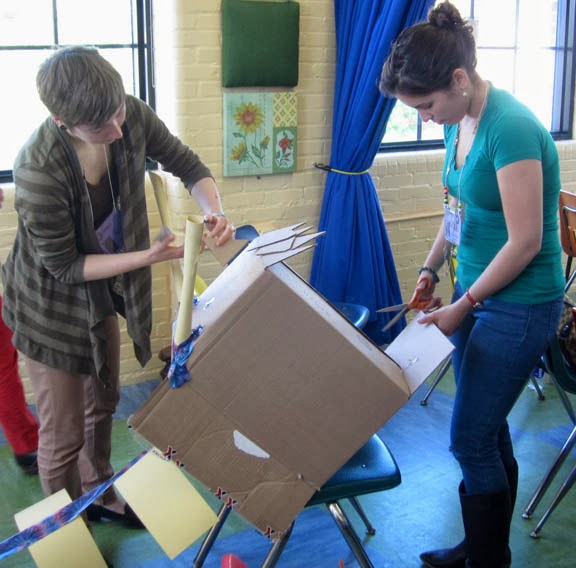
Beginning this weekend – Saturday and Sunday, October 3 & 4 – and continuing Tuesday, October 6 through Monday, October 12, kids and families will design and build original creations using cardboard, recycled materials and their imaginations. Collaborate to invent and construct games, gadgets, robots, rocket ships and much more!

In honor of Cardboard Challenge, we're reposting a favorite story of creative cardboard construction from a past year's event – sort of like our very own Caine's Arcarde!
A mom, dad and their seven kids all busied themselves with their own projects, individually or in teams. Parents and 11-year-old Alvin got to work building a drive-up coffee shop – a tall structure that required dad’s help to attach the roof and stabilize the building. They added a box to serve as the drive-through window and then mom illustrated the storefront. Alvin labored over food preparation, creating delicious donuts and M&M cookies from colorful foam shapes, which he served with coffee in small cardboard cylinders. And “Alvin's Coffee Shop” was born!


After offering free samples to rave reviews, Alvin created a menu to post by the window, took his station, and provided stellar service in a structure that mom was amazed to realized they'd spent over an hour and a half building. Watching this wonderful moment unfold, I was impressed by how Alvin’s parents followed his lead and worked seamlessly together to realize his creative vision.

Megan Fischer, Interim Executive Director

Tuesday, June 30, 2015

Providence PlayCorps Returns!


After a successful pilot in 2014, Providence PlayCorps expands this summer!  An innovative collaboration between Providence Children's Museum, the Partnership for Providence Parks and the City of Providence’s Healthy Communities Office and Department of Parks + Recreation, PlayCorps activates low-income neighborhood parks across the city with free play, art and creative exploration in conjunction with the free federal summer meals program.

Teams of trained play facilitators are a consistent presence at neighborhood parks throughout Providence.  They provide activities and materials to engage neighborhood children in physically active play, improving the overall safety of the parks while encouraging more children to take advantage of free, nutritious summer meals.  By working in neighborhood parks, PlayCorps fills the gap when school is out to ensure that Providence youth are active, safe and healthy over the summer.

From July 6 to August 21, weekdays from 11 AM to 2 PM, PlayCorps will coordinate play activities in these parks:

  • Billy Taylor Park (Mt. Hope)
  • Bucklin Park (West End)
  • Father Lennon/Camden Street Park (Smith Hill)
  • General Street Park (Wanskuck)
  • Harriet & Sayles Park (South Side)
  • Wallace Street Park (Silver Lake)
  • Zuccolo/Pastore Park (Federal Hill)

In addition, play facilitators with the PlayCorps “Playmobile” – including several members of the Museum's AmeriCorps team! – will travel to other parks and events throughout the summer.


The PlayCorps team participated in a very successful Pop-Up Play Day at Roger Williams Park on June 20, and on Monday they’ll be dispatched to their parks to begin to connect with the community and kick off an exciting summer of play – building forts, blowing bubbles, making art, making music, exploring nature, making friends and SO much more!  We’re delighted to have worked with thoughtful and committed partners to expand this important program and look forward to seeing how it grows and develops this summer.

For updates and activity announcements, follow PlayCorps on Facebook and Twitter.

PlayCorps is supported by Blue Cross Blue Shield of Rhode Island and the City of Providence’s Department of Parks + Recreation, Healthy Communities Office, and Health Equity Zone grant through the Rhode Island Department of Health.

Friday, March 13, 2015

What-a-majig? Rigamajig!

This article, by Museum Interim Director/Communications Director Megan Fischer, was also posted on Kidoinfo.

This month at the Museum, invent creative contraptions with Rigamajig, an intriguing large-scale building kit featuring wooden planks, wheels and pulleys plus rope, nuts and bolts. Conceived by our friend and RISD Industrial Design professor Cas Holman, Rigamajig inspires kids’ imaginative hands-on play, encourages engineering exploration, and cultivates collaborative construction.


Since we first introduced Rigamajig, we’ve seen kids tinker and build with tons of wonderful results, including countless forts, a mobile movie projector, small sleds and larger transport vehicles, and plenty of clever creations that defy definition!

See some great examples in this video of Rigamajig:


One of my favorite Rigamajig moments illustrates perfectly why we offer this activity especially for the Museum’s older visitors. Last summer, when we took Rigamajig out to the Museum’s annual play at the park events, an 11-year-old boy and his 10-year-old sister spent an hour constructing a wide cart, precisely placing each piece. When they were done, the boy pulled his sister a few feet in the cart – and one of the wheels popped off!


The resilient duo regrouped and remedied the dilemma to ensure the rebuilt cart was even better than before. This time, they decided to add a few decorative touches. Choosing from a selection of interesting “loose parts,” they added fabric to pad the seat, long plastic strips to circle the steering column, and some puffballs for good measure! Working together cooperatively and seamlessly, they negotiated the different ideas each sibling introduced and solved engineering and aesthetic challenges to come to an end product they were both quite happy with. Throughout their design project, their mother watched with a smile but gave her focused engineers plenty of time and space to achieve their vision.

Join us to devise your own Rigamajig creations on Tuesdays and Wednesdays, March 17, 18, 24 and 25 from 1:00 to 4:00 PM; check the calendar for future dates and times.

Learn more about Rigamajig:

Friday, August 29, 2014

Beach Adventure Play

This article, by Museum Executive Director Janice O'Donnell, was also posted on Kidoinfo.

When I describe the adventure playgrounds I explored in England and Wales to Americans, they might be delighted or appalled, but they’re always surprised. Adventure playgrounds are places absolutely committed to kids’ free self-directed play. Children build (and destroy) their own play structures, often using hammers and nails; loose parts – old tires, mud, boards, buckets, rope – abound; and taking risks is encouraged as part of healthy development. These playgrounds have a long history in northern Europe, but are rare in the US (there’s one on the UK model in Berkeley, CA) and can look chaotic and dangerous to American eyes.

But the kind of play adventure playgrounds provide isn’t actually unusual here. In fact, it happens all the time and is completely acceptable – at the beach.


As at an adventure playground, kids (and grown-ups, too) are free to alter the beach space to the limits of their abilities – dig a hole, engineer a canal system, build a castle. Open-ended play objects are everywhere – sand and water are the endlessly malleable ultimate in loose parts, plus there are shells, seaweed, sticks and stones to decorate your mud pies or sand sculptures, turn into drawing and digging tools, and wear as costumes. And appropriate risk is ever present. Small children, not yet ready to tackle deep water, challenge their own fear by running toward the receding waves and back to shore as the water rushes at them. More competent swimmers make decisions about which waves to ride and how deep to venture. And, for the most part, we let them use their own judgment to assess risk and their own abilities.

I think one reason we adults are so comfortable with open-ended, child-directed and somewhat risky adventure play at the beach is because we’re familiar with these activities. We indulge in riding waves and sculpting sand ourselves. Likewise, a lot of the adults I met at adventure playgrounds in the UK had grown up playing in just such places. They’re used to that kind of play in that kind of environment. Also, adventure playgrounds have playworkers, people well trained and experienced at supporting children’s play without directing it. Having knowledgeable adults on hand, paying close attention to what the kids are up to – but letting them – certainly mitigates any danger. Even if a child does fall off the zip line, there’s a grown-up who’ll help him out. The lifeguards at the beach play a somewhat similar role. They’ll warn us of real danger, such as a rip current, and they’ll help us if we get in trouble, but they don’t tell us how to play. They keep an eye on things without interfering.

We can learn a lot about our own attitudes toward free play and risk if we observe and reflect on our children’s and our own enjoyment of a day at the beach. Maybe we’re not as risk averse as we sometimes feel. Maybe our kids are a lot more competent and inventive than we realized.

Wednesday, July 9, 2014

Rigamajig!

New this summer, invent creative contraptions with Rigamajig, an exciting large-scale building kit featuring wooden planks, wheels and pulleys plus rope, nuts and bolts. Conceived by RISD Industrial Design professor Cas Holman (a great friend of the Museum!), Rigamajig inspires kids’ imaginative hands-on play, encourages exploration of engineering, and cultivates collaborative construction.

We’ve seen kids tinker and build with Rigamajig with some wonderful results, including a mobile movie projector, lawnmower and sled, an elaborate home/doghouse, and plenty of inspired creations that defy definition!

See some great examples in this video of Rigamajig, filmed in part at the Museum:
 

Join us to explore Rigamajig most Wednesdays, July through mid-August, from 2:00 - 4:00 PM, and at the Museum’s summer Play at the Park events.

Learn more about Rigamajig: (featuring photos taken at the Museum!)

Rigamajig and other Museum spatial thinking activities are supported by National Grid.

Thursday, May 29, 2014

Pop-Up Play Day to Kick Off Playful Providence 2014


Click here for more information
or to volunteer at Pop-Up Play Day!

Friday, December 13, 2013

DIY Play

This article, by Museum Executive Director Janice O'Donnell, was also posted on Kidoinfo.

I’ve recently returned from a visit to the UK where I spent a lot of time in “adventure playgrounds.” Not at all common in the US, adventure playgrounds are places where kids build houses and dens with scrap wood and fabric, use old tires for swings or bridges, prop boards to make ramps for bikes and skateboards, and generally create their own play. Back home, describing these places and activities, the people I’m talking with inevitably share their own childhood memories of making playthings out of found objects. They recall making forts out of boards and branches, doll clothes out of fabric scraps, telephones out of tin cans, drums out of oatmeal canisters.

The Land, an adventure playground Janice visited in Wales.
Some of my own most intense play memories involve scavenging and constructing my playthings. I loved gathering up small scraps from my father’s woodworking and incorporating them into environments for my toy animals. I vividly remember a pail filled with tiny ends of wooden pegs that I used to make miniature fences. With the creativity of children, who see the possibilities in all things, shoes became cars for our Ginny dolls to drive and perfume bottles served as fancy lamps on building block tables.

Those were ideas of the moment, suggested by the perceived similarity of one object (an ornate bottle) to another (a glass lamp). There was also, in kid culture, knowledge that passed from child to child. Maybe there still is. When we moved from the country, we copied the suburban kids who clothes-pinned baseball cards to their bicycle wheels. They made a wonderful motorcycle sound as they hit the spokes, rrrrrrrrr. A neighborhood boy showed me how to make a skateboard. We took apart outgrown roller skates and screwed the wheels to boards. I learned to measure, saw and sand making my first skateboard; I learned to measure more carefully making my second one.

We learned a lot more than that. We learned to be resourceful and think creatively. We learned to fail and to try again. We learned about the joy of accomplishment. We learned self-reliance and how to learn from others. Really important lessons that children learn best by doing it themselves.

If you’re thinking of giving a child a fancy new toy or gadget, consider DIY materials instead: woodworking tools, nails and wood scraps; cardboard boxes and tubes and lots of tape; a sewing kit, fabric pieces, buttons and old socks; paints and brushes, markers, and a roll of butcher paper. Give them the gift of making their own play.

Monday, October 28, 2013

Cardboard Challenge, part 2

A young boy (about 6 years old) entered the space and decided that, like many other participants, he was going to build a house – however his plans quickly evolved into constructing a spacecraft. He gave me detailed instructions on how he'd like his door and window cut; there was a definite sense of ownership over the project.
He drew out plans for his steering wheel and column and asked me to cut an impossibly thick tube. When I told him we'd have to use something else he scoured the room and decided that our basket for chalk would be the perfect thing to stand in for the column. He was persistent yet flexible, and it was really interesting to watch him peruse all of the materials available and decide, in the end, that what he really needed was something that we hadn't originally intended as a building supply! Upon completion, the spaceship was fully equipped with a safety sign (that indicated only the pilot should enter), wings and steering wheel. He was ready to fly!
Sarah, AmeriCorps Museum Educator

I observed adults who spent a long time helping and facilitating their children's play. I was happy to see that these grown-ups stepped back when it was time to show off their creations, to let the children explain what they have done and the reason/engineering behind it. For example, an aunt worked with her young niece and nephew to build an elaborate castle. When I asked them about details, the woman did not say a word and let the girl explain that she built the castle for "rainbow fairies, and these fairies were chased by bad guys." The castle included a drawbridge, a dangerous octopus and towers with cannons. When I asked how the cannons work, the boy demonstrated. He placed a ball in a large tube and stuck a smaller tube inside, which caused the ball to shoot out.
Olga, Early Childhood Learning Programs Developer

A girl, about 7 years old, found a sheet of cardboard with pre-cut circles (obviously some packaging leftover).  She inserted a cardboard cone in each of the circular holes and decorated them with ribbon and markers.  She asked if she could take it home as the cones were houses for fairies. She said that she had "a lot of fairies at home" and had made them a village.
Janice, Executive Director

A mom, dad and their 7 kids all busied themselves with their own projects, individually or in teams.  Parents and 11-year-old Alvin got to work building a drive-up coffee shop – a tall structure that required dad’s help to attach the roof and stabilize the building. They added a box to serve as the drive through window, and mom got to work illustrating the storefront.


Alvin himself labored over the food preparation, creating delicious donuts and M & M cookies from colorful foam shapes, which he served with coffee in small cardboard cylinders. And “Alvin's Coffee Shop” was born!

After offering free samples to rave reviews, Alvin created a menu to post by the window. When everything was ready, he took his station and provided stellar service in a structure that mom was amazed to find that they'd spent over an hour and a half building. Upon watching this wonderful moment unfold, I was struck that Alvin’s Coffee Shop might just be our own version of Caine’s Arcade!
Megan, Communications Director

Monday, October 14, 2013

Cardboard Challenge, part 1

Last weekend, we invited kids and families to design and construct original creations using cardboard, recycled materials and their imaginations.  The event was part of Global Cardboard Challenge, the second annual worldwide celebration of child creativity and the role of communities in fostering imaginative play, inspired by the video Caine's Arcade. They created castles, bridges, spaceships and much more!

We saw a lot of intriguing inventions, focused building and some wonderful collaboration.

An 8-year-old boy spent almost 45 minutes building a cannon from a large cylinder – first figuring out how to support it, then adding components like a battery and fuse. He got help from Museum staff and his caregiver when he needed it, with tape and a box cutter, but mostly worked independently and was incredibly focused.

A family of four worked diligently on three different houses! An older brother and sister worked together to create an elaborate structure that included a chimney, a porch with a bed and some pretty fancy hand-drawn wallpaper, while mom built her own red-roofed home.

Meanwhile, across the room, their young cousin claimed a large abandoned house and made it his own by adding a basket of balls to the interior and used lots of tape to form traffic barriers to secure the exterior.

A team of four kids repurposed another house, adding charming details over a period of many hours. When complete, it included tied back velvet curtains, a window box with flowers, a stained glass window, vines crawling over an outside grate, French doors, a comfy bed, a shelf stocked with toys, books and vases, and a security alarm.

A girl, about 8, created an incredible playground diorama, including a basketball hoop, seesaw, slide and trashcan. "I'm going to make the swings at home," she said proudly.

A determined boy spent quite some time constructing the "Providence bridge," thoughtfully finding just the right parts before carefully adding them on.

One of many fabulous castles that emerged throughout the weekend.

We saw lot of great grown-up play – adults playing on their own, supporting their kids’ play without taking over, being helpers and taking directions from their children, and more.

Parents built an impressive sailboat together while their 4-year-old daughter busied herself playing elsewhere.

A dad with two small children stayed for nearly the entire activity on Saturday. First they created the wall of a house, which they colored with chalk and dad embellished with colorful foam shapes. Then they each made their own smaller creations, including train tracks and a house. They had so much fun they came back on Sunday, too!

A mom and dad and their 10-year-old daughter and 6-year-old son, who create a lot of "inventions" at home, split into parent/child teams. The daughter created a cradle for her pet bunny, using loose parts to construct a dangling mobile, while mom decorated the headboard.

A family – mom, grandmom and two boys – created an interesting "factory on a ship that makes electricity."

And that's not nearly all – more stories of creative cardboard constructions will follow!

Saturday, September 21, 2013

When Work is Child’s Play

This article, by Museum Executive Director Janice O'Donnell, was also posted on Kidoinfo.

In this country, saying that someone is a professional playworker will get you blank stares, dubious looks, maybe even snickers. But in the United Kingdom, playwork – the art of supporting children’s play without directing it – is a recognized and respected profession, practiced in playgrounds, housing projects and childcare programs.

Adventure playground in Berkeley, CA

The concept of playwork originated in Europe following World War II, when children reclaimed their devastated communities by playing amid the wreckage and rubble. This inspired the creation of “adventure playgrounds,” play environments that kids can shape and reinvent by manipulating loose parts, as well as the role of playworker. Playworkers create play-rich environments, in which their presence is nearly invisible and where children freely pursue their own play, take as much risk as they can handle, solve their own conflicts, and play the way they want to for their own reasons.


Playworkers understand that all children need to play, that play is an innate impulse and is critical for healthy development. They provide open-ended environments and loose parts – elements that encourage children to choose their own play activities and narratives – and see risk taking as a positive and necessary part of kids’ play.

Playworkers describe play as “a process that is freely chosen, personally directed and intrinsically motivated.” In other words, they have no agenda for children’s play. They are not coaches training kids in athletic skills. There is no game to win unless the kids themselves organize one. They are not teachers with a curriculum to “cover” or even informal educators hoping that, by building and testing kites or puff mobiles, kids will learn something about wind power. If kids decide to make and fly kites, a playworker will take note of their endeavor. She’ll offer some materials good for kite making and ensure the kite-flying field is free of hazards like broken glass or electric wires. If the kids have organized some sort of ball game, she will help them figure out ways to include the child whose disability prevents him from throwing a ball. If a child seems unsure of how to play in an open-ended non-directive environment, the playworker might model playing, packing a mud pie herself and casually decorating it with sticks and grasses.


To respond to and extend children’s play, playworkers carefully and constantly observe kids at play so they can make good decisions about intervening – or not. And they reflect on what they observe and their own responses. “Reflective practice” also involves documenting and sharing these reflections with fellow playworkers and tapping into personal childhood memories of play. As a result, a playworker is really attuned to the play – not leading or interfering with it at all but aware of its rhythms and nuances.

Interest in playwork is growing in the US and its techniques are beginning to be employed in parks, during school recess and at children’s museums. At Providence Children’s Museum, we’ve been studying and experimenting with playwork practices both in the Museum and in our outreach initiatives. We hosted workshops with two British playworkers last spring and are excited to welcome a third this month.

Join us to learn more about playwork during a talk and training with renowned London playworker Penny Wilson and Joan Almon of the Alliance for Childhood on Wednesday, September 25, about how to restore play for children of all abilities and socio-economic backgrounds.  Click here for more information and to register.

Museum staff at a spring playwork training

Friday, September 6, 2013

A PlayFULL Summer at the Parks

This spring and summer, the Museum brought unstructured play to Providence parks for a second year, taking Imagination Playground blocks, fort building and other open-ended fun with loose parts to neighborhoods across the city.  Even though the weather wasn’t as cooperative as we’d have liked, we provided creative play experiences for 930 kids and family members, thanks to the support of the Providence Department of Parks and Recreation and the Partnership for Providence Parks.
We saw kids do some pretty incredible things and captured some of our favorite playful moments.

Imagination Playground blocks were a big hit, as always.
This giant structure was a tremendous collaborative effort.
 Adding loose parts created even more opportunities for play.
This grandma and grandson build a steep ramp and took turns rolling and catching balls. Much chasing and giggling ensued!
We also provided wood working with real tools, stick structures with dowels and rubber bands, and Rigamajig – a set of boards, pulleys, wheels, nuts and bolts that inspire creative construction.
This girl spent over two hours thoughtfully building an elaborate house. She draped it with fabric and added a doghouse. Though she welcomed construction help from other kids, when it was time to take it apart, she insisted on doing it ALL by herself.
This family with older kids approached reluctantly, skeptical about playing. But hours later, they were still busy building and rebuilding their house – here dad prepares the curtains!
This tiny teepee was barely built for two!
Cardboard was a hugely popular play material.
This cardboard dwelling – colored inside and out with chalk – had a fabric “carpet” and constantly changing occupants.
This box was occupied by one of its territorial “owners” for well over two hours!
We saw A LOT of inspired fort building with cardboard, dowels, fabric and more.
Forts...
...forts...
and MORE forts!
Thanks to our caped play crusaders and to everyone who played with us this summer!