Sunday, June 30, 2013

PlayWatch: Painting the Rabbit

This story was shared by Exhibits Director Robin Meisner

Walking out into The Children’s Garden, I noticed a girl – about 4 years old – instructing two other young children in how to “paint” the rabbit. They had lined up their materials on the ground next to the rabbit – small wooden pots from Underland filled with water and a larger bowl with sand. With a paintbrush from the sand pit in hand, the girl instructed the others, “first, you dip the brush in the water, then in the sand, then you paint the bunny.” She demonstrated dipping, then painting in long slow strokes following the direction of the rabbit’s fur. The others joined in, each getting bits of advice on proper painting techniques.


A short while later, I watched as the same girl and a young boy approached the fountain with their empty water containers and paintbrushes. They climbed onto the rocks surrounding the water, soaked their brushes and filled their pots. They then started to make their way down from the rocks but quickly discovered that climbing down with water was tricky. My first instinct was to offer my empty hands, but I held back and observed. After a few moments of fidgeting, the girl handed the boy her water, set her brush down and jumped off the wall. She then reached up and took the two filled containers and both brushes from the boy. He climbed down carefully, gathered his supplies and they made their way back to the rabbit – no adult help needed.

I followed the pair and watched as the painting continued. New children approached, got their lesson and painted for a few minutes before moving on. And, hours later after all the kids were gone, the rabbit was still specked with painted sand.

Wednesday, June 26, 2013

On Display

New in the Museum’s lobby display case: discover Blooming, a scene that celebrates the wonder of nature and its power to inspire the imagination. The display was created by AmeriCorps Museum Educator Sarah Schnurr, who described her inspiration and process.
I started coming up with concepts and sketches for the case in February – I was missing the warm weather and a lot of my ideas were about spending time outdoors! The more I sketched, the more I found myself thinking about poems, stories and children's books illustrations, specifically “The Giving Tree,” “Where the Wild Things Are” and the ee cummings poem “who knows if the moon's a balloon.”
I liked the simplicity, nostalgia and imagination of these stories and wanted to create a backyard scene that would capture that. I enjoyed working with materials kids might use in art class or at home – newspaper for the tree, paper scraps and thread for the leaves, masking tape and tubes for the tire swing, pom-poms, beads and pipe-cleaners. I also incorporated furniture and characters from the Museum’s collection of antique toys – it was really interesting to see all of the things kids used to play with and how different they are from our modern-day plastic toys.

The case was definitely a collaborative effort among the AmeriCorps members – Dylan cut hundreds of leaves, Francesca became a certified origami fashion designer and Megan lent a hand doing the tedious job of leaf-hanging.
Day.  And night.
Blooming will be on view for a while, so take a peek next time you visit to discover all of its lovely and clever details!

Friday, June 14, 2013

The Story of Nori: A Dragon Tale

Once upon a time, not so very long ago, a Children’s Museum and a Chinese dragon moved to Providence.

In 1997, the Museum was preparing to move from Pawtucket to its current building, which housed a printing business in the 1930s and, a little later, jewelry manufacturing.  Prior to the move, the Museum completely renovated the building’s interior, created two floors of imaginative exhibits, and added the atrium walkway, workshop, parking lot and landscaping, all while keeping the building’s historic character.

At the same time the Museum of Fine Arts, Boston was ready to part with a colorful dragon head, originally created for a Chinese painting exhibit by Symmetry Products (located in Lincoln, RI).

And so the dragon came to perch upon the Museum’s rooftop in July 1997.
Two years later, Julie Lancia of Symmetry Products volunteered to create a dragon tail to mark the Museum entrance.  In conjunction, the Museum held a “name the dragon” contest.  The new tail was unveiled and the name announced – Nori, suggested by 11-year-old Michael Felmly of Newport.

Although Nori is a Chinese dragon (or lung), Michael named him after a Japanese friend.  The word refers to a kind of seaweed (and a seaweed dish) and Nori is a water creature, as all Asian dragons are – appropriate, as he lives in the Ocean State.  Also common to Chinese dragons, Nori is a benevolent spirit. 

After well over a decade of dwelling above the Museum and weathering New England winters, Nori was sorely in need of a makeover.  So, over the last two weeks, Nori got a face (and tail!) lift – repairs and a fresh coat of paint – courtesy of exhibit technician Hillel.
Nori has been beloved by Museum visitors since his arrival and has also become known as a signature Providence landmark. He’s seen a lot in his 16 years at the Museum and undoubtedly has many tales to tell…
Nori watches over window replacement and other renovations in 2008.
Nori chilling in the snow.
Nori partakes in some April Fools fun.

Thursday, June 6, 2013

PlayWatch: A Climber Tale

This story was shared by AmeriCorps Museum Educator Leah Taradash

As I was sitting out in the garden with my back turned to The Climber, I heard a child yelling, “Rapunzel, Rapunzel let down your hair!” Then I heard a high-pitched voice yell back, “I can’t, it’s stuck in the beanstalk! You have to come up to get me!”


I turned around to see who was playing the part of Rapunzel, only to discover that the players were twin boys, about 7 or 8 years old. They continued in their roles for the next 20 minutes, fully engrossed in their pretend play. Rapunzel was eventually rescued by her prince, who used pretend suction cup shoes to climb the “beanstalk.” When the boys' mother noticed me watching them play and smiling, she turned to me and said that the son playing Rapunzel always talked about wanting to be an actor in movies.

Friday, May 31, 2013

PlayWatch: Water Play

This story was shared by Experience Coordinator Meg Sullivan.

During the hustle and bustle of daily life at a children’s museum, it's nice to take a break every now and then and remind myself why I’m here in the first place. Recently in Water Ways, I watched a young girl – about 4 years old – actively engage in in pretend play with “loose parts” that typically have other functions.

One of the many cool aspects of Water Ways is an array of different sized pipe pieces that allow children to construct various fountains, and it's amazing what some kids create. While at first the girl started playing with the fountain parts the “right” way, soon her imagination took hold.

A fountain top first became a cup that contained a hot beverage. She walked around blowing on it and offered some to her father, cautioning him first how hot it was. Then she took some of the little pipe pieces, filled those with water, and poured them back into the large fountain top. As she stirred it with a smaller piece, she muttered to herself about her concoction. Once she tired of pretending it was a beverage, she started using the fountain head in other ways. She emptied it into the waterfall, into the plastic boats, and finally into the water table itself. She stirred her mixture again in the water table with a little pipe piece.


This pretending went on for the full hour I was there and I rather wished I knew what she was picturing. Working at a children’s museum allows me to relive the imagination and wonderment that we all felt as children!

Tuesday, May 21, 2013

Image & Illusion

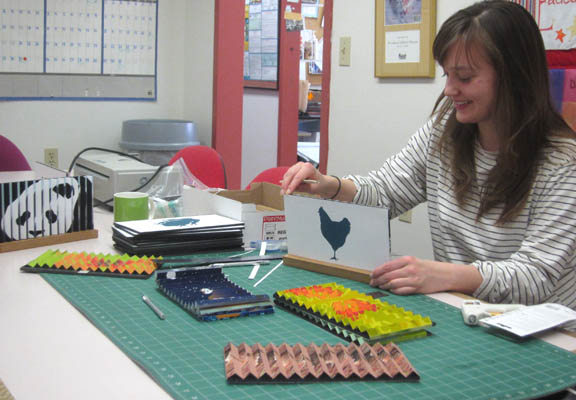
Image & Illusion, the most recent display in the Museum’s atrium walkway, invites visitors to peek into the 17 window boxes to discover a range of representations of different animals. Created by Museum intern Robin Hayashi (with guidance from the exhibits team), the boxes feature illusionary images that shift with perspective between photographs and graphic depictions.

Robin, who has worked at the Museum since January 2010 and is graduating from RISD this spring with a degree in graphic design, described her inspiration and process.

Each box has three different images of the same animal: one photograph, one graphic and one silhouette. Walking by each box, the image changes, providing an exciting and playful transformation that capitalizes on the ramp's natural use as a walkway.


As a graphic designer, I have always been inspired by different ways of representing the same idea. After figuring out how the folded paper illusion works, I collected images of animals, ranging from familiar farm animals to spectacular sea creatures. Then I created colorful graphics that correspond to each photograph but show the animal in an alternate view, perhaps just the animal's face if the photograph depicts the whole body, or vice versa. I also developed a very simple silhouette, much a logo, of each animal.


I wanted to show the ways different arrangements of shape and color can communicate the same thing. A photograph of five pigs in a barn, a simple pink pig nose and a the outline of a pig's shape all say, "Pig!" I hope that visitors are inspired by the simple magic of images on folded paper – perhaps even enough to make their own! 
Image & Illusion will be on display through June, so come see for yourselves!

Monday, April 29, 2013

Turn Off the Books

This post by Education Programs Coordinator Jillian Finkle (also posted on Kidoinfo) is in honor of Screen-Free Week (April 29-May 5, 2013), a national celebration presented by Campaign for a Commercial-Free Childhood that encourages children, families, schools and communities to turn off screen media for a week – to unplug, play, read, create, explore.


My 3-year-old, like any kid, loves to watch TV and play electronic games. We limit his time with these activities but it’s always a battle. I can’t understand why screens are more attractive than the free, open-ended play we promote at the Museum, and sometimes I worry that I’m being too strict about it. But so far I’ve held my ground, even though it feels like the entire world is working against me: from televisions in restaurants, to relatives with iPads, to toothbrushes with cartoon characters on them. At least he loves books, too!

We all know that American kids in general are watching too much TV. The American Academy of Pediatrics recommends limiting children’s screen time (which also includes computers, tablets, and video games) to 1-2 hours of quality media per day for children over age 2 – and none for children younger than 2. These experts cite the need for physical activity and interpersonal interactions and the prevalence of violence even in children’s programming.


To further complicate the issue for parents, e-reading devices have now entered the mix. A recent Scholastic reading study reported that the number of children using e-readers has doubled since 2010. While some of the kids’ story “apps” are little more than subtitled television that read the story for you, perhaps with interactive animated illustrations, others are just like actual books. So then, do they count as “screens”? What difference does it make if a child reads a paper book or an electronic one?

For older children, there can be benefits to using e-readers. Many of them have embedded dictionaries so children can easily look up words they don’t know. The adjustability of font size allows for fewer words on the “page” at a time, which can help focus struggling readers or children with dyslexia. It’s easy to download new content, and many libraries now loan e-titles along with regular books. And then there’s the cool factor – some children might be more likely to read or to read more on an electronic device.

For young children, reading books with adults builds vocabulary and interest in reading and allows for adult-child attention and closeness. Don’t we get those things whether we read a book together on paper or a screen?

Not necessarily. First there is young children’s need for real objects and experiences, and they can’t always distinguish what’s real from what happens on a screen. And turning pages is a physical skill to be learned. But most importantly, it is the adults’ words and actions beyond the story itself that makes reading to children most beneficial, and those are different when we use e-readers.

According a 2011 Temple University study, adult-child conversation was more about the use of the device itself than about the story when reading books electronically, and that impeded children’s story comprehension. Another study at Vanderbilt University found that adults asked fewer story-related questions with video screen content as opposed to a physical book. And of course if there are things to touch on the screen, it can distract a child from the story.

Why not try cutting out or cutting down on the screens during Screen-Free Week? Go outside and play, build a blanket fort, or visit the Museum instead. I’ll be pulling out the most creative ideas in my bag of tricks to make it the best possible week for my 3-year old!


Want to unplug this week? Take the pledge from Campaign for a Commercial-Free Childhood, and find guides for participating in Screen-Free Week. For more screen-free resources, download the Museum's Kids, Play and Digital Media resource sheet.